Is your Cat Depressed?

by Jessica Vogelsang, DVM and comments by Diane Weinmann

 

You’re probably familiar with Grumpy Cat, the little feline whose frown has made her famous across the internet. You may also be familiar with your own grumpy cat, if you happen to have a particularly temperamental one at home.


Cats are known for their diverse, often feisty, personalities; some are anxious, some reserved, others inquisitive. But what does it mean if your cat is acting depressed? Do cats even suffer from depression? Well, yes and no.


How is Depression in Cats Defined?


Certainly cats can exhibit depressed behavior, but the general consensus is that they do not experience the same emotional changes associated with clinical depression in humans.


“In general, depression in humans is considered a multifactorial disease,” says Dr. Lynn Hendrix, the owner of Beloved Pet Mobile Vet in Davis, California and a palliative care expert. Depression can be situational, caused by a stressful situation, or medical, due to chemical imbalances in the brain. The diagnosis is based on self-reported symptoms, says Hendrix, meaning that the symptoms can be expressed verbally to the doctor or psychologist.


Those diagnostic criteria are not available to veterinarians. Since  most people  can’t ask cats exactly what they are feeling, whether they’re sad or angry or anxious or joyous, they must rely on the clues that the cat gives us through their behavior and daily activities and make our assessments based on that.  If  you talk with an animal communicator you can find out for sure.


“The clinical signs we see tend to be loss of appetite, avoidance behavior, less active, and abnormal behavior, like hissing,” says Hendrix. Some cats may show changes in litterbox usage, while others have disturbed sleep patterns.


Other Causes for Symptoms of Depression in Cats


Unfortunately, those symptoms are caused by a wide variety of conditions in felines, so getting to the root of the problem usually involves a visit to the veterinarian to rule out other problems. Medical problems such as kidney disease or GI cancer can cause nausea and decreased appetite that mimic depression.


According to Hendrix, pain is one of the most underdiagnosed conditions in cats, seniors in particular, and is one of the leading causes of clinical signs of depression. “Most of the time, there is pain or physical disease causing a cat to act ‘depressed’,” she says.


In Hendrix’s experience, many pet owners who are dealing with terminally cats are concerned that their cat is experiencing depression, often mirroring their own sadness about a pet’s illness. Hendrix encourages those owners to consider medical causes instead. Often, “it is sick behavior,” she says. “Their terminal illness [is] making them feel sick, nauseous, painful.”


As a hospice and palliative care veterinarian, Hendrix is able to address those specific symptoms and help cats feel much more comfortable, even during the end of life process. In some cases, owners who were considering euthanasia actually postponed their decision due to the improvement in their pet’s temperament once proper treatment was instituted. For that reason, she recommends people seek veterinary care for pets exhibiting depressed behavior, as accurate diagnosis and treatment can significantly improve quality of life.


The Evaluation Process for Depression in Cats


Veterinarians will begin the evaluation by taking a full history of the symptoms and performing a complete physical examination.


“Bloodwork, chest x-rays, and abdominal ultrasound may be suggested by your veterinarian,” says Hendrix. Those baseline tests usually provide a good overall look at a pet’s health and organ function. Depending on the results, other tests may be recommended.  Infections, tumors, and inflammatory diseases of the nervous system can result in significant behavioral changes in cats. Changes due solely to stress and anxiety can be difficult to differentiate from medical conditions, so it is often a process of elimination to reach a diagnosis in cats.


Again, if the issue is physical in nature these tests will help; however, if the cause of the depression is emotional, you will learn nothing.  At that point you should consult an animal communicator, like Diane Weinmann, to determine how to proceed.


Although cats tend to be independent and resilient, they can suffer from anxiety due to changes in routine, feeling threatened, or the addition or loss of family members. Anxiety is, in fact, one of the major behavioral conditions seen by veterinarians. Chronic stress can have an impact on a pet’s emotional, and even physical, health. Self-inflicted hair loss, aggression, or changes in litterbox usage are often traced back to anxiety.


Treating the Cat’s Stress Instead of Depression


If a stressor can be identified and eliminated, often the symptoms will improve or resolve. A veterinarian, trainer or animal communicator experienced in cat behavior can help with recommendations to make a home environment less stressful to an anxious cat. A cat that feels exposed and doesn’t have a place to hide, for example, may respond to more covered furniture or additional vertical spaces in the house so he or she feels more in control of the environment.


Competition in multi-cat households can also cause stress. Depending on the situation, owners may need to add resources in the form of additional litterboxes and food bowls, or even separate cats that are not getting along.


As another environmental modification, some cats respond to pheromone diffusers such as Feliway, which can have a calming effect.  Diane has had success with essential oils and bach flower essences to alleviate emotional issues.


Using Medication to Treat Stress in Cats


For more severe cases, veterinarians can prescribe prescription medications which have been known to help with anxiety in some cats. Trazodone, gabapentin, alprazolam, and midazolam are just some of the options that a veterinarian may recommend, depending on the situation.


Regardless of the cause, a cat showing signs of depression can benefit greatly from a prompt evaluation by a veterinarian. If we resist applying the human definitions of mood disorders to our feline friends and instead evaluate them strictly from a cat-friendly perspective, there is often much we can do to make our beloved kitties happier and healthier!  If the issue doesn’t seem to be physical—call an animal communicator (like Diane Weinmann-  www.theloveofanimals.com)


Are European Dogs Born Well-Behaved?

By Dr. Becker and comments by Diane Weinmann

If you’ve ever visited Europe, you might have noticed that European pets, generally speaking, are quite well-behaved — maybe more so than dogs born and raised in the U.S.

One couple who moved from Dallas to London found that perhaps their dogs weren’t quite “ready for prime time” in comparison with the dogs that had been raised in their new country. They wondered if it was just their imagination. Determined to get to the bottom of their growing suspicion that their pups might need a little more tweaking in the behavioral department, they asked a friend, who happened to be a professional dog trainer, to give them some pointers.

Throughout Belgium, France and other places throughout the United Kingdom, Kama Brown, a certified professional dog trainer-knowledge assessed (CPDT-KA), kept her eye peeled for any wisdom she could glean regarding European dogs, as well as their owners.1

Is It Me or Is It My Dog?

One of the first things Brown noticed was the freedom most dogs enjoyed, but well-deserved. She was intrigued to see that most dogs were off leash, even when they visited museums, toy stores and markets and rode on trains, trolleys and elevators. Only when waterfowl were present were European dogs leashed.

She also noticed that when children wanted to approach dogs on the street, they were told to “avoid distracting them,” and that admonition was consistent everywhere. Dogs weren’t asked to wait while their owners went inside stores or eateries, or to lie under tables on the train or tram. The dogs did so without being told. Still, Brown observed:

“Young dogs in Europe did the same things as young dogs in America. A [9]-month-old black Labrador jumped onto a counter to sniff the cheese selection at the market. A small mixed breed stopped to sniff each interesting spot.

When a young Bulldog resisted going down the stairs to the Underground, the owner coaxed him down each new step. A man with a very young puppy walked quickly to keep the puppy from picking up objects he found along the way. Nothing I saw made me think that European dogs were born well behaved.”2

Another of her observations was that dogs were basically ignored. No one fawned over them, asked owners if they could give their pets food morsels or even pet them. The non-interaction extended to other dogs; owners avoided letting their dogs sniff, stand near or play with other dogs.

How Dogs in Europe Are Trained to Behave

The more Brown found herself in areas where dogs were plentiful, the more she realized what she was seeing was very close to the way service dogs are trained and treated in the U.S. Owners do their best to maintain a calm, comfortable environment, which encourages them to be calm and quiet, as well.

When service dogs in the U.S. walk through crowds or encounter people, their owners and trainers are always pleased when no one approaches them to pet them, talk to them or get in their dogs’ space. Strangers, when wise, don’t encourage interaction at all with dogs they’re not familiar with, and that’s how owners of service dogs typically like it.

The simple reason for this is that such interaction does distract dogs. It puts them in conflict, even in the presence of their owners, because the signals aren’t consistent. Brown explains:

“We treat service dogs this way because we understand that interacting with them makes training harder for their handler. When strangers frequently offer treats and attention, or allow their dogs to rush into another dog’s space, it produces specific emotional responses, which will arise each time a new person or a strange dog approaches. Sometimes, this emotion is pleasure, but more often, anxiety, over-exuberance or defensive behavior is manifested.”3

Strangers’ Interaction With Dogs Distracts and Confuses Them

One of the most interesting phenomena on this side of the pond is how little most people, including dog owners, understand that lavishing praise and conversation on any and all dogs is setting those dogs and owners up for failure, Brown asserts. Further, the fact that dogs aren’t restricted from many areas helps them become more acclimated to different environments, which helps them remain calm rather than unsure of what’s happening and how to respond. Brown says:

“If being taken to new places were a regular occurrence, it would not excite a dog into lunging through doorways. If barking and pulling were consistently ignored in young dogs, those behaviors could never become a game or a way to get attention. Unlike the restrictions put on U.S. dog owners, Europeans are able to consistently expose their dogs to new sounds, sights and smells, which mentally enriches the dogs without overstimulating them.”4

Determining not to acknowledge a dog you (or your children) are not familiar with may be one of the best things you can do for them. Owners don’t have to calm or reassure dogs that become overexcited when strangers don’t approach or engage them. Brown says that lack of distraction allows dogs to relax and focus on their owners.

The upshot for Brown’s newly planted London dwellers was that they could relax, too. Just living in a European city would be three-quarters of the way toward success because their dogs would be ignored! The key to socialization was their dogs’ simple presence — not constant attention. Other than bonding with their pup or pups and teaching basic manners, nothing else would be needed. Except perhaps a little “schooling” for over-attentive dog lovers.

I can tell you that when I was on Santa Margarita (wonderful place in Italy) I wandered into a non-descript church but was completely amazed at the interior that was breath-taking!  As I stayed to enjoy the mass and the ambience I realized that there were dogs all over in the church just laying at the owner’s feet.  I thought this was the greatest thing since sliced bread and I highly recommend that our beloved USA get a clue!

My Moment


Do you ever get down in the dumps?  Feel like life is going nowhere or that it is not what you planned or expected?  We’ve all been there.  Life can be a real downer sometimes.  I am not going to sit here and tell you that there is a silver lining and that you should count your blessings but I will tell you how I handle those set- backs in my life.  I remember.


It came to me as I was convalescing from a terrible accident that caused me to have three operations and forced me to stop doing one of the things in life that brought me my greatest joy—horseback riding.  I have had horse for 42 years and now I am horse-less thanks to this accident.  In order to try to bring sense to my life I pondered on what gave me joy.  I am truly blessed with a wonderful family, friends and I am retired from my 9-5 banking job.  This freedom enabled me to concentrate my talents where my heart always led me all my life—to animals.


So then I thought, what has been my defining moment in my life?  Was it my wedding? No, I am happily married to a wonderful man, who I love with all my heart, but that was not a defining moment for me.  Was my moment when I gave birth to my pride and joy –my son?  No, although I have been blessed to have a great child who is the one of the biggest blessing I have in life– his birth was not my defining moment.  Was it the 35 years I spent in banking, working myself up from entry level to being in charge or over 50 people?  Definitely not!  That was what I had to do to survive. It was a career, not just a job, but I wasn’t doing what I longed for–what made my heart sing.

You know what I mean by defining moment—when you are so proud of what you, yourself, have accomplished, on your own, using your own talents? Then I closed my eyes and thought what have I done that made me proud to be me?  Then it came to me—I saw myself, standing up behind a podium talking at my book launch party about the book I had written.  A Tail of Hope’s Faith was an accumulation of years of learning, practicing and working with animals.  It defines who I am deep down inside—it is who I am and who I will always want to be and what I believe in my soul. 

So when I get down in the dumps, when I think life is not as interesting without my precious horses in it– I picture myself behind that podium.  I smile and tears come to my eyes as I remember that moment.  I am so very proud that I was able to change someone’s life, to bring comfort and healing to an animal and her family and then to document it for anyone else who may be going through the same experience of a terminally ill pet.  That’s my moment—that’s what I am proudest of! 

What is your moment?  We all have one.  Think about it and then recall it whenever you need a reminder that you are freaking awesome and no one can take that away from you!

Is It Normal to Talk to Pets?

Is It Normal to Talk to Pets?

by Dr. Elfenbein

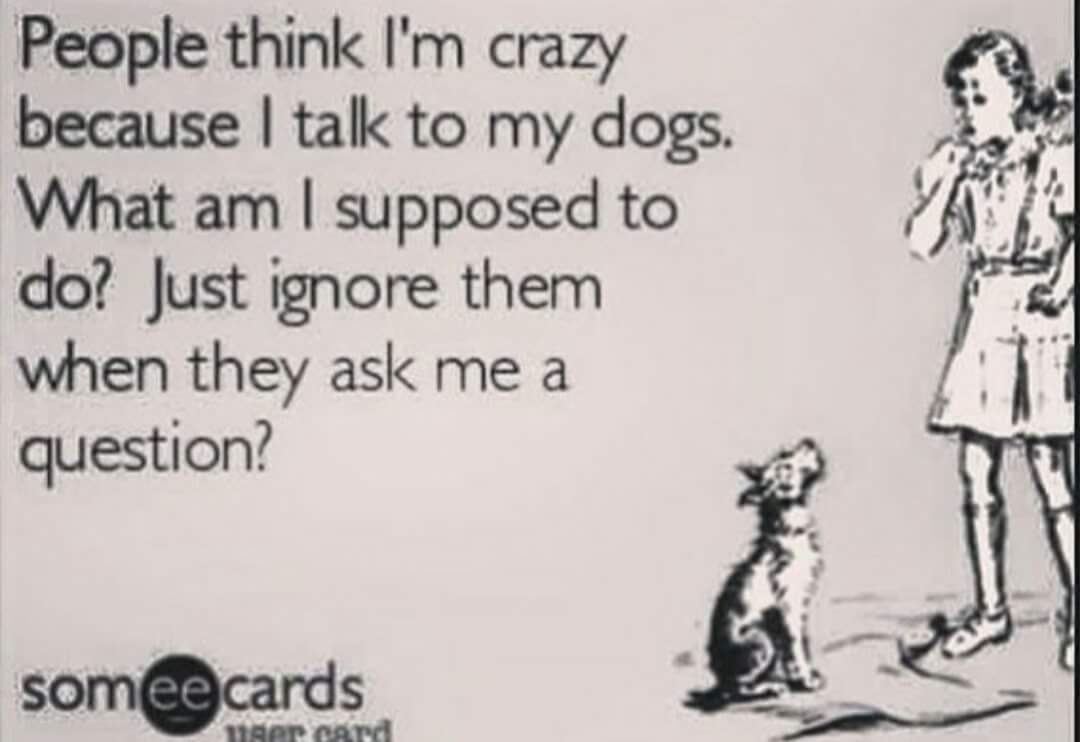
I talk to my dog. I also talk to all the other dogs at the dog park. I may not be a “normal” person in all respects, but I don’t think this is one of my questionable character traits. I think it’s totally normal to talk to animals—and not just to ask if they want to play fetch.


From the time I was a little kid, I talked to my dog. I could tell him anything, and he wouldn’t judge me or tell me what I should do. As I’ve grown up, the contents of the conversations have changed, but I still turn to my animals to say things that I can’t or don’t want to tell another person. Sometimes we just need to say what’s on our minds, and cats and dogs lend a willing ear. There is no need to hold back what we say for their sake.


Pets Can Recognize Human Emotion


Some people say that talking to my pets means I am anthropomorphizing them, or assigning human characteristics to non-human entities. I disagree. Dogs and cats have evolved side by-side with humans for tens of thousands of years to understand human emotion. Much of that is probably based on our body language, but the tone of our voice also tells our furry family members how we feel. Those clues tell our dogs and cats what we need from them.


I don’t think that my dog knows what I’m telling him, but he knows the way my voice sounds when I’m sad, tired, or frustrated, and he tries to make me feel better. There were many nights during veterinary school when I put my head next to my cat to listen to his purr as I cried to him about feeling overwhelmed. Talking to my pets helps me feel better and, bigger picture, it’s a way to strengthen our bond.


On the flipside, your dog will learn to understand more words than just “sit” and “dog park.” Be consistent when you are talking to your pet with the intention that they learn the meaning of what you say or take an action as a result of the word. For example, “off” and “down” might mean the same thing to you when your puppy jumps, but you might also use “down” to mean a laying position. That can be confusing for your pup, which can slow down the training process.


Pets Offer Unconditional Love


We invite dogs and cats into our family for their unconditional love—their willingness to listen to all of our complaints and tolerate all of our bad habits and love us anyway. In my opinion, anything we can do to make our pets know how important they are is a good thing. Talking to them, unlike giving them treats, won’t cause side effects like weight gain. Pets are meant to be spoiled, and including them in conversation is one way to express how much we love them.


Talking to our dogs and cats is also key to the science that says pets are important for mental and physical health. According to the Centers for Disease Control and Prevention, pet parents are less likely to feel lonely than those who live without pets. I think part of that is having someone who always listens. There is also research that shows that talking in a happy tone if you are feeling sad or angry can actually help you feel happier—just like fake laughing can turn into real laughing.


My dog is my companion. He goes on walks and runs with me, he hangs out with me in the apartment, he drives with me to work, and he’s always ready for an adventure. With that much time together, I can’t imagine not talking to him about all the things that happen in between our cuddle sessions.


Dr. Elfenbein is a veterinarian and animal behaviorist located in Atlanta. Her mission is to provide pet parents with the information they need to have happy, and healthy, and fulfilled relationships with their dogs and cats.


Moody Horses

Emotions have a powerful influence on how an individual behaves and views the world.1  The negative emotions that go along with mood swings can lead to pessimistic thinking and impact quality of life. Exactly what causes moodiness isn’t well understood. Various aspects of a horse’s environment and biology affect its emotional state, and a few of these are presented below.

If you are a horse owner or has been involved with horses at all you have heard the old saying “mood mares” are the worst! Let’s explore why that is….by the way all the mares that I have owned (2) were very sweet and not moody at all!

What Causes Mood Swings?DSCN2662_0011

Medical conditions

A veterinarian should exam a horses that experience mood fluctuations or persistent negative emotions. Moodiness can be a sign of underlying health issues that flare up periodically, such as allergies, joint and muscular pain, gastrointestinal issues, and disorders of the nervous and endocrine system. In humans, mood fluctuations are also associated with psychiatric conditions such as depression, bipolar disorder, and attention-deficit hyperactivity disorder. Whether horses suffer from these same mental disorders is not known. Previous injuries can cause occasional discomfort and associated changes in mood. If your horse grinds his teeth, it could be a sign that he is experiencing physical discomfort or stress.

Anxiety and stress

Moodiness has been linked to anxiety, and a string of bad days can lead to a loss of emotional control. Animals with an anxious temperament or who experience chronic stress tend to be more on edge, and negative emotions can be easily triggered by seemingly irrelevant or minor events. Interestingly, a recent study found that young horses showed larger swings in emotions than older horses in response in response to novel objects.2 Controlling mood swings caused by anxiety requires identifying and eliminating the sources of stress from the environment.

Hormonal changes

Hormones are known to play a role in controlling emotions and managing stress. They’re often blamed when a mare is moody, but much more is known about how hormones act on equine reproductive behavior than about how they affect emotions. Hormonal irregularities, including abnormal levels of thyroid and adrenal hormones, can cause fluctuations in emotions.  In humans, disruptions in daily activity can also lead to hormonal imbalances and increase the risk of mood disorders, including depression, bipolar disorder, and seasonal affective disorder.  It’s possible that disturbed routines also cause hormonal imbalances and moodiness in some horses. Sticking to a predictable routine by structuring activities at the same time every day can help maintain normal daily hormonal balance and stabilize mood.

“Keeping a journal can help identify patterns related to the horse’s shifting moods.”

Disrupted sleep

Disrupted sleep is closely linked to mood and anxiety disorders in humans, and when deprived of rapid eye movement (REM) sleep, people often become sad and irritable. Horses also suffer from sleep deprivation if they get less than 60 minutes of REM sleep a day, on average, for about a week. This can happen if the horse is unable to lay down in a laterally recumbent position, because of physical discomfort, insufficient space, insecurity about the environment, or social pressure.3 A horse deprived of REM sleep will become visibly drowsy, but it isn’t known if sleep disturbances are linked to negative moods in horses as they are in people.

Environment

Even when mood swings seem occur without rhyme or reason, the horse is probably reacting to something that the owner simply didn’t experience or notice. Events in the environment are nearly always involved to some extent in triggering negative emotions in a moody horse. Keeping a journal can help identify patterns related to the horse’s shifting moods.  It’s important to think broadly by looking at the horse’s routine, activities, locations, time of day, weather, social interactions, diet, and more.  Nutrition is considered a vital component to mood management; consult with an equine nutritionist for advice about your horse’s diet and feeding schedule.

Training the Moody Horsehorse-carrot

Figuring out the reasons for a horse’s mood swings can be complex, and negative emotions can interfere with and frustrate training. When your horse is having a bad day, being flexible and adopting a different approach can help. Below are some general strategies that can be used to protect against the emotional highs and lows.

  • Environmental and behavioral enrichment can reduce a horse’s baseline anxiety and vulnerability to stressors. Providing more positive experiences in general and during training can reduce a horse’s pessimistic outlook and improve mood.
  • Moody horses should get regular physical exercise, so don’t give up and put your horse back into his stall when he’s in a bad mood. Exercise causes the body to produce endorphins, and these hormones can help reduce the effects of stress and improve mood. Voluntary exercise is thought to be more beneficial than forced exercise.
  • Avoid punishing a moody horse; it will only make his negative outlook and emotions even worse. Instead, readjust your expectations and demands.  Set the horse up for success by removing stressors from the environment, asking the horse to complete simple tasks, and generously rewarding his small successes.

These strategies will have limited success if there is an underlying medical problem, so consult with a veterinarian first if your horse has emotional swings or persistent negative moods.


References

1 Briefer Freymond, S., Briefer, E.F., Zollinger, A., Gindrat-von Allmen, Y., Wyss, C., and Bachmann, I.  (2014) Behaviour or horses in a judgment bias test associated with positive or negative reinforcement.  Applied Animal Behaviour Science 158, 34-45.

2  Baragli, P., Vitale, V., Banti, L., and Sighieri, C. (2014) Effect of aging on behavioural and physiological responses to a stressful stimulus in horses (Equus caballus).  Behaviour 151, 1513-1533.

3 Larson, E.  (2012) Understanding equine sleep deprivation.  The Horse (April 4), http://www.thehorse.com/articles/28927/understanding-equine-sleep-deprivation

By Robin Foster, PhD, CAAB, IAABC-Certified Horse Behavior Consultant and comments by Diane Weinmann

Robin Foster, PhD, CAAB, IAABC-Certified Horse Behavior Consultant, is a research professor at the University of Puget Sound in Seattle, Washington, and an affiliate professor at the University of Washington. She holds a doctorate in animal behavior and has taught courses in animal learning and behavior for more than 20 years. Her research looks at temperament, stress, and burn-out as they relate to the selection, retention, and welfare of therapy horses. She also provides private behavior consultations and training services

13112755_641026502720401_5286172465589240582_o

HORSE EMOTIONS

by Annabel Kent and comments by Diane Weinmannhorse and boy

Can your horse sense your mood? “We can hide our irritation from other people by masking our emotions, because humans are not good at reading energy fields,” says Margrit Coates, a part-time lecturer in the Department of Animal Behavior at Southampton University, and author of Healing for Horses and Horses Talking: How to Share Healing Messages with the Horses in your Life (www.thehorsehealer.com).

“A horse will read and see through everything we are feeling. Emotional health must be in control. We need to be a confident leader emotionally with our horses.” This means we need to be very vigilant about how we’re feeling when we’re around our horses.

“We need to look deeper at our inner state because the horse reacts to the truth,” says Margrit. “If horses could speak or write they would tell us exactly how we are. We cannot put horses into human boxes, analysing these animals as types from our viewpoint. Horses are full of emotional instinct, and the nearest we ever get to associating with a wild animal. “Past experiences will program a horse to behave in a certain way,” she adds. “They are incredibly emotional animals. Even our own past experiences will emotionally affect how we are with our horses. If we have been told that we are useless and feel it, this will come through when we are around horses. Finding it difficult to take criticism can also have an effect on our behavior.

This philosophy includes other people who will be working with your horse. “Before getting a trainer, you need to look at the emotional state, characteristics and qualities of that trainer before you let him/her near your horse, as they have a massive influence upon your horse emotionally.”

Training? Be happy “The first rule is that if you feel tense and angry, just don’t bother to school your horse,” says Sheila Bryant, who has been riding and training horses for over 30 years and uses the Bowen technique professionally on both horses and humans (www.healthwithbowen.co.uk). “When it comes to schooling, you need to feel emotionally positive and relaxed. Otherwise the horse will pick up on your mood and respond negatively.”

Sheila emphasizes the value of checking your breathing. “Is it easy and relaxed? This is of paramount importance as your breathing can influence the purity, strength and speed of your pace. If it’s ragged and aggressive, imagine what that can do to the horse.”

Breathing is also important to Jenny Rolfe, a classical trainer and author of the upcoming book, Ride from the Heart (www.spanishdressagehorses.co.uk). She has based her training methods on the horse’s sensitivity to our breathing. In her book, she shows how we can use lateral breathing exercises to help master our emotions and lead to a feeling of calmness. The horse responds to the deep breathing, becoming the rider’s emotional mirror, and the rider can then influence him with calm leadership.

“We can sometimes forget we are not programming a machine,” adds Jenny. “Horses are living animals. We have to make a conscious effort, especially in the beginning, to be very self-aware and vigilant about where our emotions are when training horses. By becoming aware of how much more perceptive horses are than humans, we then start to make it work for us when communicating with our horses. We need to treat them as our friends, not naughty students. We need to be emotionally consistent to develop a strong, solid relationship. It is no good being patient one day and impatient the next.”

For the best ride, Jenny also advises warming up to determine how your horse is feeling that day. “Loose work is very good before riding as it not only helps prepare the horse for ridden work, but it’s another way for the trainer to find out where her mood is at, rather than getting straight on without a thought,” says Jenny.

The same goes for you as the rider. If you’re feeling emotional, it’s important to get your feelings in line before riding, since the emotional and the physical are so deeply connected. “If we can learn to control our emotions and feelings, then we can control our physical body,” explains Jenny. “Rarely can we have a thought without a reaction from our body.”horse with girl

As an animal communicator, Diane can vouch for the fact that horses pick up on our moods and thoughts.  The minute you are around a horse, they know what you are thinking and what you’ve been through.  When I was sad, my horse would put her head against mine and just kind of sigh.  We would stand like that, head to head, for minutes on end just being with each other and sharing without saying a word.  It was hugely comforting to Diane and her horse felt that she had provided a great service to her beloved owner—which she had.

As you can see, emotions are the driving force behind everything we do, and play a huge part in how we and our horses learn. So take the time to stop and think about how you’re feeling when arriving at the stable. Look in that imaginary mirror before you get out of the car. Do it again when standing next to your horse, and you will feel it. A happy you is a happy horse.

Horse friends (2)

Kitties — Gentle Souls

Kitties—Gentle Souls

 heart cat

by Dr. Becker and Diane Weinmann

Cats are adored for their strong will and independent spirit. It’s what makes cats cats. But despite their seemingly aloof nature, cats are not unbreakable physically or even emotionally speaking.


If you value your cats’ spirit, you’ll want to avoid the following habits. As Pet360 shared, these are surefire ways to zap your kitty’s true feline nature.

10 Habits That May Crush Your Cat’s Spirit

  1. Not Cleaning the Litter Box

Virtually all cats demand a clean litter box. If you neglect to clean yours regularly, your cat may very well find a new place to do her business. And can you blame her?

While cats vary in how particular they are about a clean litter box (some won’t use it if there’s any feces in it while others will tolerate it), all cats deserve a clean ‘bathroom.’

I recommend scooping all feces and urine clumps, and removing any litter or urine/feces stuck to the sides or bottom of the box with a damp paper towel, twice a day. Dry any wiped areas thoroughly before scooping dry litter back over it.

This regimen of keeping the sides and floor of the box clean and dry may help extend the time between full box clean-outs. Even so, you should dispose of all used litter and clean the box out entirely at least once a week.

It’s important to wash the container thoroughly to remove as much odor as possible. This lowers the chances that your kitty will become averse to using her litter box due to a lingering smell.

The box should be washed with plain hot water. If you use soap, choose a natural, fragrance-free variety. Avoid any cleaning product that is scented or contains potential toxins.

  1. Shouting

Most cats are very sensitive to loud noises, including the sound of a human yelling. Many cats will run and find a place to hide if yelling ensues, even if it’s not directed at her. For your cat’s sake (and everyone else in the household), keep yelling to a minimum.

  1. Punishing

Punishing your cat for bad behavior is likely to backfire. Your cat probably won’t understand why you’re scolding her, but she will learn to be afraid when you do. If your cat has a problem behavior, you’re far better off getting to the bottom of it than attempting to punish the behavior.


As a point of reference…my cat Aaron did something my husband didn’t like and so my husband yelled at him and chased him with a broom as I stood there screaming to leave him alone. Once all the drama was over my cat calmly jumped up on our couch table, carefully picking his way around my belongings to go to my husband’s limit edition collectable and deliberately knocked it on the ground where it smashed into a million pieces. I TRIED not to laugh…..


  1. Ignoring Her Pain

Cats are excellent at masking feelings of discomfort and pain, so it takes an observant, attentive owner to spot a kitty in need. Signals of acute pain in cats include changes in posture, activity level, attitude, vocalization, appetite, facial expression and reaction to being touched or handled.


There may also be noticeable changes in her eyes, ears and whiskers. Changes in behavior, especially a cat that retreats or hides or loses her appetite, should be checked out by a veterinarian.

  1. Leaving Her in the Dark

Cats can see much better in the dark than you can, but they cannot see in total darkness. Plus, a cat left alone in the dark may feel lonely or abandoned.

If you’ll be gone for an extended period, have a trusted friend, neighbor or pet sitter come to your home for once or twice daily visits. You may want to leave on a nightlight or even a quiet radio or television to give your kitty some additional companionship while you’re away.


  1. Teasing

This should be common knowledge to cat owners, but you’ll want to avoid teasing your cat or treating her like a toy (this goes for children too). So, no pulling her tail, ruffling her fur, blowing in her face or even picking her up if she dislikes it.

  1. Grooming Her Infrequently

Cats are fastidious groomers, but they still need help to maintain their coat and nails. How much grooming your cat requires depends a great deal on the type and texture of the fur, as well as your pet’s age, lifestyle and health status.

Older cats may have trouble grooming themselves, for instance, while cats with “pushed in” faces (such as Himalayans or Persians) may need the folds of their skin cleaned to prevent infection. Your cat also needs regular brushing and may even need an occasional bath.


  1. Hurting/Intimidating

Hurting or intimidating your cat in any way—hitting, kicking, swatting with a newspaper, etc.—will teach your cat to fear people and will quickly break her spirit.

  1. Changing Her Water Bowl Infrequently

Cats should have access to fresh water daily, but some cat owners will leave a bowl of water out for days on end without changing it or washing the bowl. Your cat likes clean, fresh water just like you do. Some cats also enjoy taking a sip of water from the running tap as well (make sure you filter your tap water). In fact, this is why I always had company in the bathroom. I could never sneak in to be alone because the cat would follow me to jump up on the sink and meow at me until I turned on the water to let him drink. If I didn’t go to the bathroom often enough my kitty would sit outside of the bathroom an “talk” to me demanding his refreshment!

  1. Ignoring Her

Cats can be independent but most still love regular attention, affection and playtime.

Cats use multiple methods of communication and will actually follow your lead in terms of how much involvement the two of you share.1 So if you take the time to regularly give your cat love and attention, she’ll reward you with the same in return. My husband learned this the hard way when he tried to read the newspaper when the cat felt he need more attention. The cat would simply jump onto his lap and climb on top of the paper making it impossible for him to read it.


A Private Goodbye Ritual

Rainbow bridge with animalsYou have lost one of the loves of your life.  Your beloved pet.  How do you deal with the pain, grief and go on living day to day.  It is not easy, but love rarely is.  Honor your pet, your love for them and their meaning in your life.  Maybe these tips below will help you in that task:

How to Prepare:


Take some time out from your busy schedule

Set aside a half hour or more

Find a quiet, comfortable place to sit.

Play a piece of music that opens your heart


While this time of loss is sad and painful, it helps to take a moment in silence to reflect on the memories of your beloved pet.


Take a moment – Sit in a place where you will be undisturbed for a while and make it a sacred moment.

Reflect – Consider what a privilege it has been to have shared your life with such a special soul.  Consider that each of our pets is assigned to us for a particular reason and for a specific length of time.

Recall the lessons and the love.  As you hold your pet’s memory in your heart, reflect upon how he/she came into your life and what you learned from them.

Know that you are richer.  Focus on this until you rise above the tears and you become aware of a wealth of experiences that made your life richer in so many ways.

Celebrate a life.  Take joy in these memories and let them lighten your heart.

wishing

8 Things Only Cat People Understand

By Dr. Becker and Diane Weinmannneed a little help

As cat people we know they are let’s say…unique! We expect odd behaviors from time to time and we love them for it. If you are a cat person you are totally different from a dog person and you know it!  Let’s explore some of the unique characteristics of cats:

  1. Cats don’t respect personal boundaries (except their own). Cat guardians are accustomed to sharing every square inch of space with their favorite feline.

For example, most kitties figure out early in life that a human sitting on a toilet is a captive audience and the perfect target for some leg bunting (this is when your cat repeatedly head butts your lower legs and rubs against them).

Bathtub time is their’s also…don’t think you are going in to the tub to be alone and have a nice quiet soak..oh no, your cat will still want your attention! My cat used to walk around the rim and once or twice has inadvertently joined my husband in the tub quite a shock for them both!

Needless to say, this isn’t a two-way street, so don’t dare even look in the direction of kitty when she’s busy in her litterbox.


  1. The house belongs to the cat. Anyone with the audacity to shrink Fluffy’s territory by closing doors to certain rooms will live to regret it – especially if he or she is on one side of the door while kitty’s on the other. There will be howling, scratching, thumping, and paws appearing and disappearing under the door.

More than a few clever cats have figured out how to work door handles after being locked out of rooms in “their” house.

Don’t get me started on the paws under the door reaching for help when they are locked in a specific room!

  1. All sunny spots also belong to the cat. Cats prefer an ambient temperature about 20 degrees warmer than most humans find comfortable, so they figure out creative ways to stay warm.

That’s why kitties tend to stretch out in patches of sunshine wherever they may fall – on the floor, on furniture, on a windowsill, or right in the middle of your desk or the kitchen counter as you’re working.

Learning the spots where sunshine falls and clearing them ahead of time for Miss Kitty is the least you can do for She Who Will Not Be Denied.

  1. If it moves, it’s prey. And this goes double if whatever “it” is moves quickly, furtively, or is underneath something. Obviously this makes for a very long list of “prey” around the house, including anything real or imagined moving under bed covers, paperwork, and area rugs.

It also includes your ankles if kitty happens to be stalking you as you walk from room to room, and your toes if you move them underneath the sheets as you sleep.

The good news is that once kitty has caught you with a quick swipe or dig of his sharp claws, he’ll take off the second you scream out in pain. Until next time.

Also good news is that pests like flies, mosquitos and moths don’t stand a chance and are really affordable toys for your feline!

  1. The vacuum is evil. It’s ungodly loud, and cats hate loud. You cat could care less how you remove the fur he so generously deposits all over everything – he’d put that varmint vacuum out of the house if he could.

Short of that, he’d like you to at least show some respect for his delicate sensibilities and warn him before you turn the horrible thing on.

  1. A cat’s backend is every bit as cute as his frontend. Let’s say you’re lying on the couch or in bed and kitty jumps up on your chest in an affectionate mood. You scratch his head or stroke the fur on his back, and the next thing you know, his tail is raised and his bottom is an inch from your face.

Cat guardians realize this is just a feline’s way of being sociable. Your kitty is looking for attention and affection from you. You can try turning him to face you, but take no offense, since none is intended. Smell me!

  1. The human head is an excellent rubbing or licking post. Most cats enjoy rubbing against things as much or more than they enjoy being petted. And as your kitty’s human, it’s your job to cooperate while she uses your face or head as a rubbing or licking post. This can get a bit dicey if you’re sensitive to cat fur or dander and Fluffy seems determined to shove her head into your mouth or up your nose. In that case, it’s best to try to distract her with some petting or a toy.

Many cats also head bunt the top of their human’s head. If your kitty does this, she’s rubbing her scent on you so that everyone knows you belong to her. Now you’re in their “club”!

  1. The best time to meow really loud is at night when the house is quiet. Sometimes cats vocalize for a reason, for example, it’s mealtime or they’re saying hi as you come through the door. Other times, they meow for no conceivable reason. This is especially true of older kitties.

People with elderly cats are often awakened multiple times during the night by throaty, sometimes blood-curdling yowls, howls, and meows. The first few times it happens, we leap from our beds, sure a knife-wielding cat slayer has snuck into the house. Next, we visit the vet to make sure the otherworldly noises coming from kitty aren’t health-related.

Finally, we devise ways to sleep through the midnight wailing, because as we’ve also learned, there’s no “shushing” a cat. Just know that you house will not be desirable to a burglar if your cat is “cat-r-waling” at the top of his lungs!


Can Your Dog Tell If You’re Happy or Mad?

Can Your Dog Tell If You’re Happy or Mad?

By Dr. Becker and Diane Weinmanndog-listening-big-ear-27392035

Does your dog ever look you in the eye and seem to know exactly what you’re thinking? This isn’t all in your imagination. Dogs are keen observers and have adapted to living closely with humans for more than 10,000 years.

Shown below is some scientific research on how dogs can interpret your mood. Now, as an animal communicator, I can tell you without a shadow of a doubt that your dog can communicate and understand everything you say—they just do it mostly through telepathy- which is my specialty! Many of you can understand what you dog needs or is saying based on their actions and body language. This is your way of receiving communication from your pet. My way, since I never really met most of my clients, I receive the information using a picture of your pet. So what do you think a picture can tell you? Probably diddily-squat! But for me, as I look into your pet’s eyes, I can connect with their mind and soul and tell you everything. Many people who have never experienced animal communication do not believe in it. This information below is basically for them so they can scientifically understand how they pet “knows” them!

New research published in the journal Current Biology confirmed that pet dogs can, indeed, discriminate emotional expressions in human faces. A group of dogs were first trained to associate pictures of happy or angry faces with a treat reward.

The dogs were shown pictures of half faces (either the upper half or lower half of a face) showing happy or angry emotions. Half were given a treat when they touched their nose to a happy face while the other half were rewarded for touching the angry faces.

The dogs were then tested using pictures of faces they hadn’t seen before or showing parts of the face that were new to the dog (so a dog that had previously seen the lower half of a face would be shown the upper half).

The results showed the dogs were quite clever and able to differentiate between the different emotions.

Dogs Likely Can Discriminate Between Happy and Angry

Dr. Kun Guo, a psychologist and expert in Human-Animal Interaction from the University of Lincoln, told BBC News:

“Showing dogs only half of the face and then the other half separately means they can’t rely on the shape of the eyes or the mouth — they must have some sort of template in their mind … So it looks like they can really discriminate between happy and angry.”

The researchers speculated that dogs probably used their memories of real emotional human faces to help them complete the experiment successfully. Interestingly, during the training portion of the study it took the dogs about three times longer to learn to touch an angry face.

The researchers said it seemed as though they didn’t like to touch an angry face, and perhaps they really have an understanding that an angry face is something they do not like.3 Another thing dogs seem not to like? People who are mean to their owners.

Dogs Snub People Who Are Mean to Their Owners

Research led by Kazuo Fujita, a professor of Comparative Cognition at Kyoto University, showed that dogs will refuse food offered by someone who was uncooperative to their owner.

For the study, dogs watched as a person either helped their owner open a box, actively refused to help with the task, or behaved in a neutral manner. The strangers then offered food to the dog.

It turned out the dogs were more likely to choose food being offered by the neutral party and refuse food offered by the uncooperative party.The study shows the dogs make social and emotional evaluations of people and may make decisions based on those evaluations, even if it doesn’t benefit them directly. Fujita told Discovery News:

“We discovered for the first time that dogs make social and emotional evaluations of people regardless of their direct interest … This ability is one of key factors in building a highly collaborative society, and this study shows that dogs share that ability with humans.”

Dogs Will Stop Trusting a Person Who Lies

Separate research has even shown dogs learn when a person is not trustworthy and no longer follow their commands. In one study, all dogs initially went to a container that a researcher pointed to, under which a bit of food was hidden. The researchers next pointed to an empty container after showing the dogs that food was hidden under a different container. Then, in the final phase, the researchers again pointed the dogs toward the correct container with the hidden food. However, by this point the dogs were no longer willing to trust him and only 8 percent went in the direction he pointed. According to the study:

“These results suggest that not only [are] dogs … highly skilled at understanding human pointing gestures, but also they make inferences about the reliability of a human who presents cues and consequently modify their behavior flexibly depending on the inference.”

Your Dog Listens When You Talk

Research has shown that the average dog understands about 165 different words, although they may learn many more if you train them to.

It’s known that dogs pay attention to the tone of your voice, the pitch and the rhythm in your speech, and research suggests dogs also sense a difference between the verbal and emotional components of speech.


Dogs appear to process emotional cues and meanings of words in different hemispheres of the brain, similar to humans. Dogs also pay attention to your body language, taking note of your posture and eye contact, for instance.


Dogs will follow your gaze similarly to a 6-month-old infant, but only if you convey the intention of communication, which suggests they’re quite in-tune with your communicative signals. Dogs have even been shown to experience cross-species empathy in response to a crying baby. In humans, levels of the stress hormone cortisol tend to rise in response to an infant crying, which is said to be a primitive form of empathy. Research shows that dogs, too, experience increases in cortisol levels when a human infant cries.


Dogs also displayed a combination of submissive and alert behavior in response to the cries. According to the study, published in Behavioral Processes:

“These findings suggest that dogs experience emotional contagion in response to human infant crying and provide the first clear evidence of a primitive form of cross-species empathy.”

Taken together all the research suggests dogs and humans have developed many forms of communication that allow us to understand one another. Of course, if you’re a dog owner you probably knew that already. If you are one of my clients—you already know how it REALLY works!Think I am crazy