Avoidable Mistakes Owners Make When Their Dog Meets Another

By Dr. Becker and Diane Weinmanndog meets dog
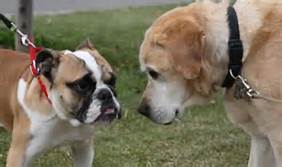
Whether you’re adding a new dog to your family, watching a friend’s pet for a couple of weeks or passing other doggy friends on your morning walk, your dog has plenty of opportunities to make new acquaintances.  Friends are good right???

The difference between those meetings going pleasantly or possibly turning aggressive lies, to some extent, with you and how you approach these delicate dog-to-dog introductions.

Unlike people, who walk right up to one another, look each other in the eye and shake hands upon first meeting, dogs prefer to greet one another in a more roundabout way. A direct frontal approach may cause tension or even aggression among two dogs, especially unfamiliar dogs.

Further, while dogs are social animals, they also have a defined hierarchy within their own packs. Adding a new dog to your family will disrupt this hierarchy until each dog learns their new place in the pack.

The first meeting is incredibly important and can set the stage for the rest of the relationship. In order to help your dog make friends, not foes, here’s what can help, according to Karen B. London, Ph. D., a certified applied animal behaviorist.1

10 Top Tips for New Dog-to-Dog Introductions

  1. Meet One-on-One

Your dog should meet new dogs one at a time, as group meetings can be overwhelming. This is one reason why some dogs don’t do well at dog parks.


  1. Meet on Neutral Ground

Avoiding setting up the meeting in your dog’s (or the other dog’s) territory, which may make the dogs feel an intruder is coming in. A neutral location is best. Choose a park or a completely neutral place –neither of the dog’s back yards!


  1. Let the Dogs Meet Outside

Sometimes a dog will urinate when meeting a new dog, and then walk away to help diffuse tension. The other dog can then sniff the urine and get to know the other dog this way before coming into closer contact.

If the meeting is indoors, housetrained dogs will probably avoid urinating and therefore miss out on this important method of introduction.

  1. Give the Dogs Room to Roam

Holding an introduction in a tight space can be stressful for the dogs, who will prefer room to move freely. This doesn’t mean you should let your dog run loose, but rather use a leash (with some slack) and hold the meeting in the middle of your backyard as opposed to near a fence or doorway.

If you can safely do so (such as in a fenced backyard with two non-aggressive dogs), drop the leash and let your dog approach the other dog as he wishes. (Leave the leash on, however, in case you need to grab it to diffuse tension). Ensure the leash does not get tangled on anything that would cause your dog to feel trapped or vunerable!

  1. Avoid Hovering Over Your Dog

You may want to stay close in case something goes wrong, but hovering over your dog will add to his tension. You should give the dogs space to say hello, and if the situation seems to be getting too stressful, move away from the dogs to lower arousal.

  1. Try a Moving Introduction

If you walk purposefully during the introduction (such as between two dogs on a sidewalk), it helps prevent the meeting from getting overly intense.

  1. Stay Calm

Your dog will sense your emotions about the meeting and respond in suit. If you’re nervous, stressed or overly excited, your dog may be too. A better option is to stay calm, breathe slowly and portray a relaxed attitude to your dog.


  1. Avoid Bringing Toys or Food

Meeting a new dog is stimulating enough — add in treats and toys and the situation can quickly escalate out of control. Plus, your dog may feel possessive about the food and treats, leading to issues between the dogs.

  1. Keep it Short

A few minutes is long enough for an initial interaction between two unfamiliar dogs. It keeps the meeting fun and interesting while leaving less time for things to get tense. For dogs that are easily stressed, a short meeting will be essential to keep your dog from feeling overwhelmed.

  1. Introduce Your Dogs Ahead of Time

It’s possible to let dogs become familiar with one another before they actually meet. This can be done by letting your dog smell the other dog’s urine or by keeping them in close vicinity without an actual greeting (such as walking two dogs side-by-side, but a few feet apart). Smelling clothes that have the other dog’s scent is a great way to introduce your pet to a new friend ahead of the actual face to face!

Bringing Home a New Pet? Plan to Take a Few Days Off Work

The first week your new dog spends in your home is a crucial time of building new relationships, between you and your dog as well as your dog and any other pets. I recommend taking at least a few days off of work — and ideally about a week — so you can stay home and focus on your new addition.

This is the time you can introduce your dog to your daily routine, which will give him a sense of security, as well as take time to slowly introduce him to your other pets.

If your dog has been rescued from a shelter, keep in mind that the transition may take more time. I recommend using Bach Flower Essences to assist in your rescue’s adjustment to his new home.


You should not force any new introductions on a dog that’s not ready; allow him to get to know his new housemates at his own pace. Senior pets may also need additional time and attention when adjusting to a new pet in your home.

A separate space for both pets to retreat to where they feel safe is the ideal atmosphere. Do not force them together rather let they come to it naturally and watch the toy and food sharing. I recommend feeding in same room but not next to each other, rather place food bowls far from each other and have two separate water bowls.


Watching all new pet associations carefully to diffuse any aggression. New friends are great –we all love them and your pet will too if it is approached in a safe way.

goofy meet friend

Heat Stroke – Recognize the signs in your dog!

Information compliments of Dog’s Naturally Magazine

Hot weather is here and you’re walking along with your 80-pound, long-haired shepherd one warm, sunny afternoon. You’re breaking a bit of a sweat, but you feel just fine in your shorts and tank. But then you look over at Thor, and he’s not looking too good … his eyes are glazed, he’s panting heavily and he’s starting to pull back on the leash.

“But, it’s not that hot,” you say to yourself. “What is up with Thor?”

Thor is probably on his way to having heatstroke, which means he is quickly losing his ability to regulate his body temperature because of an overabundance of heat. Dogs don’t sweat the way we do – they only have sweat glands in their nose and pads of their feet. And their only real recourse when they are overheating is to pant, which sometimes isn’t enough. Add to that the fact that their bodies are covered in fur and their paws are usually in direct contact with hot concrete or asphalt … and well, it’s easy to see how they can get much hotter than we can – fast.

And since heatstroke can quickly lead to irreversible damage to major organs like the kidneys, liver, heart, brain – and can even cause death – it’s important to know the signs.

How Do I Know If My Dog Has Heatstroke?

Normally, a dog’s body temperature is somewhere between 100.5 to 102.5 degrees Fahrenheit, slightly higher than for humans. A dog will start to experience heatstroke at over 105 degrees. At around 106 to 108 degrees, organ damage can occur. Always keep a rectal thermometer handy for your dog and check his temperature if you suspect heatstroke.

Other signs to look out for include:

🔹Excessive panting

🔹Excessive thirst

🔹Glazed eyes

🔹Hyperventilation

🔹Increased salivation

🔹Dry gums that are pale or grayish

🔹Bright or dark red tongue or gums

🔹Rapid or erratic pulse

🔹Weakness

🔹Staggering

🔹Confusion

🔹Inattention

🔹Vomiting

🔹Diarrhea

🔹Rectal bleeding

🔹Collapse

If the overheating isn’t stopped, your dog’s breathing will slow or stop, and he can have seizures or fall into a coma. Obviously, we don’t want any of that to happen. So, what should you do if you think your dog has heatstroke?

My Dog Has Heatstroke, What Do I Do?

Whenever the weather gets warms, it’s a good idea to pay special attention to how your dog is doing. And know your dog: Breeds with “flat faces” like Pugs and Boxers, elderly dogs, puppies and sick dogs are at even greater risk of overheating. Things progress quickly when it comes to heatstroke, so as soon as you detect a problem, act quickly.

Get him into shade.

Since heat is the obvious problem, the goal is to get him out of it and away from direct sunlight.

Apply cool water.

Get water on his inner thighs and stomach where there are more large blood vessels, and on the pads of his feet. Use running water via faucet or hose and avoid submerging your dog in a tub or pool because this could cool him too fast and cause other problems like cardiac arrest and bloat. Also, avoid cold water or ice because these will cause the blood vessels to constrict, slowing blood flow and the cooling process.

Air him out.

To help cool your dog, you want to make sure the water you’re putting on him can evaporate. To that end, you’ll want to avoid covering him up with a wet towel or blanket because rather than allowing the water to evaporate, this will create a sauna effect – which you don’t want. Keep him out of enclosed areas like a kennel; instead, keep him near flowing air like from a fan or air conditioner.

I witnessed this in my own dog just yesterday!  He was panting, a lot! I immediately put him into my family room which is freezing cold with the air conditioner going and I put the ceiling fan on him.

Keep him moving.

Encourage your dog to stand or walk slowly while he’s cooling down, so that his cooled blood can circulate throughout his body.

Give him small amounts of cool – not cold – water.

If he gulps down too much water too fast, it can cause vomiting or bloating.  With my dog,  I put some water from the refrigerator into his bowl to “freshen it up” and make it cool.

Give him some chicken or beef broth

…if he doesn’t want water, but avoid human performance drinks.

Get him to the vet.

Once your dog has started to cool down, you can stop your efforts and take him to his vet right away. You don’t want to continue trying to cool down your dog for too long or you’ll risk him getting hypothermia. Your dog will need a veterinary exam even if he seems fine because there may be underlying damage to his organs that you can’t see. Even if he seems normal, the effects of heatstroke can continue for 48 to 72 hours following the initial heatstroke. According to William Grant DVM, the most common cause of death following heatstroke is disseminated intravascular coagulopathy (DIC) which is blood coagulating throughout the body; it can occur hours or days after the heatstroke episode.

In my situation, it was not necessary to take my dog to the vet.  He bounced back and seemed fine in a short period of time.  It was so humid outside that my husband probably didn’t think about what he was subjecting the husky to when they went for a walk in the neighborhood and I had a friend over and wasn’t paying attention until they got back and I saw my dog panting so much!  I can guarantee you that this situation will NEVER happen again!

(Courtesy of Robert Newman and Diane Weinmann)

3 Homeopathic Remedies for an Overheated Dog

In addition to cooling down your overheated dog and taking him to the vet, consider giving him one of these homeopathic remedies to help in his recovery.

Aconitum napellus 6C to 30C
This is a good first choice at first sign of heatstroke. If your dog needs this remedy, he may also seem very fearful or anxious. Give three pellets every 10 minutes for up to three doses. If he doesn’t seem better, try one of the other remedies listed.

Gelsemium 30C
If the dog needs this remedy, he may seem very weak and his muscles may be trembling. Give three pellets every 10 minutes for up to three doses. If the dog is not any better, try the next remedy.

Glonoinum 6C to 30C
You may see vomiting and weakness. His gums may be pale, red or have a bluish cast. Give three pellets every 5 minutes.

Pet CPR

http://www.nbcmiami.com/news/local/Help-My-Pet-Isnt-Breathing-How-To-Administer-CPR-To-Your-Pet-300548141.html

CPR for your Dog

By Dr. Ian Kupkee

April is the American Red Cross’s Pet First Aid Awareness Month. What better time to go over the basics of administering CPR to your pet?

Let me start by saying I hope my readers never need this information. No pet parent wants to think about the possibility that their pet might stop breathing and collapse. Unfortunately, the unthinkable can, and sometimes does, happen. Knowing the basics of CPR can give pet owners the confidence needed to stay calm and work the problem in a life or death situation.

Be Prepared

One of the basic elements of pet CPR is the chest compression. I’ll get to the details in a moment, but before administering chest compressions, you must first be able to locate your pet’s heartbeat. In the spirit of preparedness, it’s a good idea to learn how to do this before an emergency strikes. When your pet is lying on her right side, the heart will be facing upward. Gently pull the front leg back, and feel for the heartbeat near what we would call the armpit. You can also find a pulse at the femoral artery, but the heartbeat is the easiest to find. This activity can easily be incorporated into routine down time with your pet. You can take your time, and your pet will simply think she is getting a massage! The more you practice, the more easily you will be able to locate your pet’s heartbeat. Be prepared. You don’t want to waste time finding it in an emergency situation when every second counts

The ABC’s of CPR

Now let’s imagine a worst-case scenario. Fluffy has collapsed. First, call for help. If you can perform CPR while someone else drives you to the vet, you will greatly improve your pet’s chances. Next, remember your ABC’s. In addition to being very easy to remember, in rescue medicine, ABC is an acronym: Airway Breathing Compression

Check to see if she is breathing by watching for a rise and fall of the chest, and putting your face close to her mouth in an attempt to hear or feel any breaths. If she has indeed stopped breathing, you will need to open the Airway by lining up the head with the neck. Next, open the mouth, gently pull out the tongue, and have a look inside. You’re looking for a foreign body that might be blocking the Airway. If you see one, reach inside and pull it out. Get your hand out of the mouth quickly, as the pet may wake up startled, and frightened animals often bite. If there’s nothing there, you’ll need to start rescue Breathing. Hold the pet’s muzzle closed, put your mouth over the nose of a large dog, or the nose and mouth of a small dog or cat. Give four to five quick rescue Breaths – not too deeply, just enough to make the chest rise. Make sure the chest falls between Breaths. Check for a heartbeat, and if you don’t feel one, you’ll need to start chest Compressions.

Before beginning chest Compressions, be sure Fluffy is lying on her right side, so that the heart faces upward. Place the heel of your hand over the heart, lock your hands together, straighten the arms and give 30 rapid chest Compressions. For a large dog, Compressions should go down about two to three inches. For small dogs and cats, a half inch to full inch is an adequate Compression. After your 30 Compressions give two more rescue breaths, then resume chest compressions. This is called a cycle, and is defined by 30 compressions, followed by two rescue breaths. After four cycles – or about one minute – check again for a heartbeat and signs of independant breathing. If you can’t find either, keep going – 30 compressions, two rescue breaths.

You can continue for as long as 20 minutes, but by then, you really need to be at your vet’s office or an emergency clinic if you want to give your pet the best chance of survival.

This truncated recap can be printed out and placed in your pet’s first aid kit – Know how to find your pet’s heartbeat in advance. – Know your ABC’s: Airway, Breathing, Compression. – In an emergency situation, call for help and get someone to drive you to the vet. -Lie your pet on the right side. -Quickly check for heartbeat and breathing -Align the head and neck -Pull the tongue out -Look inside for a foreign body -Close the muzzle, give 4-5 rescue breaths -Check for signs of life -Give 30 chest compressions -Give two rescue breaths -Repeat three more times -Check for signs of life -Keep going if needed

Remember, your can really increase your pet’s chances if you do this on the way to the vet. Even if you are able to revive your pet at home, get her to the vet for follow up care and observation. Diagnostics performed in the wake of an emergency can give your veterinarian an idea as to what caused the crisis in the first place. There is nothing quite like the rush one gets from successfully administering CPR. That being said, you’re not likely to want to do it again anytime soon.

http://www.nbcmiami.com/news/local/Help-My-Pet-Isnt-Breathing-How-To-Administer-CPR-To-Your-Pet-300548141.html

dog with vet
dog with vet