10 Signs of Cancer to Keep an Eye Out for in Your Senior Dog

10 Signs of Cancer to Keep an Eye Out for in Your Senior Dog

Veterinarian Reviewed by Dr. Janice Huntingford, DVM on August 8, 2018
Posted in Dog Cancer as seen in PetWellbeing


Your dog is getting older and as they do, you want to be on the lookout for potential health concerns that may impact their quality of life in their later years. Cancer is one such disease your dog can develop as they age and it’s a leading cause of death in older canines. In some cases, cancer is treatable, but it needs to be caught early on. Here are 10 of the most common signs of developing cancer in aging dogs:

  1. Loss of appetite: Your dog eats normally, but suddenly is inattentive to his food or eating smaller and smaller portions, disinterested in treats or other food that used to bring joy. This may be a sign that your dog has a loss of appetite or there has been a change in health that is preventing an interest in food. This could indicate a larger problem.
  1. Problems eating: Perhaps it is not loss of appetite, but instead a physical problem with being able to eat? Loss of teeth could be an explanation, but cancer of either the mouth or throat could also be a potential cause. If it seems that your dog is in pain while eating, affecting how much they eat, it may be time to take them in to the vet.
  2. Weight loss: Loss of appetite and problems eating could result in significant weight loss. If you do not catch the first two problems, you will likely notice the change in your dog’s physical appearance. Significant weight loss for any reason is unhealthy, but it could signal a disease like cancer.
  3. Lumps, bulges and signs of tumors: Every time you groom your dog, or even after taking them for a walk outside, you should be in the habit of doing a general check of your dog’s body. Besides any tics or other things that could cause problems with your dog’s health or skin, you may also find unnatural lumps that could signal the initial stages of a tumor. If you are unsure whether or not what you have found is benign, be sure to take your dog to the vet.
  4. Open wounds that do not heal: When your dog goes for a walk or hike with you, it may be a frequent occurrence to find scratches or scrapes on their skin. It is not normal, however, if these continue to bleed or remain unhealed for long periods of time. This could signal the dog’s inability to heal, which may be part of a larger problem.
  5. Vomiting/diarrhea: If your dog is either vomiting or having diarrhea, it’s likely the result of something they ate or that upset their stomach. However, whenever both vomiting and diarrhea are present at the same time, this is an emergency situation. Take your dog to the emergency vet right away to be looked at and taken care of.
  1. Bad odor: Bad odor can come from a variety of places and have a variety of causes. However, if your dog has extremely bad breath or smells even after teeth brushing or grooming/bathing, it may be time to have a vet check on the cause. It could be that a tumor or lesion is causing the odor.

7.Problems relieving themselves: If you notice that your dog is bending in a strange way to relieve themselves, or even yelping in pain, this is a sign something is wrong. This could indicate a disease in the area, or any number or skin-related issues that could be causing pain or distress in your dog.

  1. Increased lethargy: Your dog is normally a ball of energy, bouncing around the house and begging to be let outside. But now, he is quiet, sleepy, and laying down for inordinate amounts of time. This increased lethargy could have a variety of causes, but one reason could be the amount of energy your dog’s body is using to fight a disease or larger problem. He may simply not have enough energy leftover to spend doing the things he loves, like begging for treats.


  1. Stiffness of joints: Lethargy and stiffness of joints can be easy to mix up, and so it is important to pay attention to how your dog reacts to long walks or having to jump in and out of the car. Stiffness of joints can prevent these activities and can be attributed to arthritis or be indicative of a larger issue.

Caught early, cancer is more treatable than if realized in a more advanced stage. Be sure to provide your dog with routine veterinary visits as part of your prevention plan. And if your dog exhibits any combination of symptoms above, consider taking them right away to seek medical attention. Your senior dog may not be as spry as they once were, but that doesn’t mean they’re not tough enough to fight back against cancer if it develops!


Reducing Vet Clinic Anxiety: Fear Free, Low Stress Handling and Cat Friendly Veterinarians

Reducing Vet Clinic Anxiety: Fear Free, Low Stress Handling and Cat Friendly Veterinarians

By Victoria Schade and comments by Diane Weinmann

A visit to the vet clinic can be stressful for both pets and their people. For many cats and dogs, a simple wellness exam is actually a series of increasingly scary and uncomfortable manipulations that might result in the animal lashing out at the practitioner. And for pet parents, the stress of watching their best friend go through necessary yet anxiety-inducing exams might deter them from returning to the veterinarian for important health checks.


That doesn’t have to be the case. Three revolutionary certifications are changing the way veterinarians interact with their patients, and in turn, are changing the way pets and their people view their time in the vet clinic. Practitioners report less stress on both sides of the exam table, which leads to better diagnostics and happier, healthier patients.


What Is Fear Free Certification?


Developed by Dr. Marty Becker in 2016, the mission of Fear Free Certification is to prevent and alleviate fear, anxiety and stress in pets by inspiring and educating the people who care for them. The certification process includes a series of courses, both online and in person, that is available to veterinary professionals as well as all individuals employed at a vet clinic, from veterinarians and nurses to customer service representatives and practice managers.


The Difference Between Traditional and Fear Free Handling


According to Dr. Joanne Loeffler, DVM and Fear Free Certified Practitioner at the Telford Veterinary Hospital in Telford, Pennsylvania, the primary difference is the way the practitioner interacts with the patient.


“The traditional way of doing veterinary medicine was to make the pet deal with whatever procedure we needed to get done,” says Dr. Loeffler. “That would mean pinning an animal down, forceful restraint, etc., for sometimes unnecessary things, like a nail trim.”


Dr. Loeffler says that using Fear Free techniques allows the practitioner to change their approach to consider the animal’s emotional state in order to accomplish procedures. She adds, “Fear Free is a culture change from the way most of us were taught how to handle animals. In the time I’ve been involved in Fear Free, I’ve seen such a change in the compliance rate of my patients and clients. Fear Free is about treating the animal with respect and working with them to realize the vet’s office isn’t such a scary place.”


Fear Free Certification and the Diagnostic Process


“Lower stress means better diagnostics,” says Dr. Loeffler. “By having a more compliant patient, we can get more accurate heart rates, temperatures and blood pressures, and even some bloodwork values (like glucose) are more accurately assessed on a calm patient versus a stressed one. Also, when a pet has continued low-stress visits with us, a pet owner will be more likely to bring them in earlier if they get sick, which often translates into a better and quicker response to treatment.”


What Is the Cat Friendly Practice Program?


Established by the American Association of Feline Practitioners (AAFP) and the International Society for Feline Medicine (ISFM), the Cat Friendly Practice program (CFP) is a global initiative designed to elevate care for cats by reducing the stress for the cat, the caregiver and the entire veterinary team.


According to Dr. Elizabeth J. Colleran, DVM, MS, Diplomate Feline Specialty Practice and Cat Friendly Practice Task Force Chair, CFP is a self-paced online program that walks veterinary practices and professionals through all the tasks necessary to reduce the fear and stress of a cat’s visit to the vet clinic.


How Cat Stress at the Veterinarian Is Different Than Dog Stress


“Cats have a very deep connection to their home. They don’t like to leave it. Ever.” Dr. Colleran explains. “The anxiety begins as soon as they leave their ‘home range.’ From there, each new experience adds a bit more stress: strangers, loud noises, unusual odors, quick movements. Once fully anxious, they will stay that way for a long, long time. Cats have uniquely heightened senses and are more sensitive to stimuli than many other animals—sensations can be overwhelming for cats.”


Cats can also show redirection anger, which means that they will lash out at anyone in front of them at the peak moment of stress. Many owners will try to calm their cats during stressful times, putting themselves at risk of scratching, or even worse, a cat bite.


Benefits for Veterinarians Using Cat Friendly Practice Protocols


Cat Friendly Practice veterinarians note that the designation can decrease anxiety for everyone in the exam room. In a 2017 survey, CFP veterinarians said that their patients are less stressed; their clients are happier about the visit experience; and their clients noticed that how much these specialized vets care about cats. “Understanding how cats experience the world gives CFPs the tools to make the changes essential to make health care easy,” Dr. Loeffler says.


What Is Low Stress Handling Certification?


The Low Stress Handling Certification program was developed by Dr. Sophia Yin and released in 2014. Certification involves completing 10 online lecture and lab courses, passing a multiple-choice exam at the end of each lecture, and passing a final multiple-choice exam. Dr. Sally J. Foote, DVM, CABC-IAABC, LSHC-S and Low Stress Handling Silver Certified veterinarian states, “This is an in-depth program in the fundamentals of behavior, understanding the patient in front of you right now, and how to approach and deliver care right now to this animal in a less stressful way.”


The Difference Between Traditional and Low Stress Handling


Dr. Foote notes a connection between the traditional use of force during an exam and the animal’s stress levels. “The most common misstep by veterinary clinics not using Low Stress is adding more people for restraint to get the job done, like vaccinations, nails or blood draw, and not removing or reducing the triggers that are increasing the stress in the animal.” She adds that recognizing when the animal has had enough, and either using medication to assist the exam process or splitting up care, is also important for the health of the animal and safety of the practitioner.


How Does Low Stress Handling Aid Veterinarians and Pets?


Low Stress Handling techniques teach veterinarians to better understand the emotional states of the animals they’re examining, which can reduce the animal’s reactivity, and in turn reduce injury risk to the practitioner. Dr. Foote states that clients are more likely to come in when care is needed rather than trying to avoid the stress of care on the pet.


“I have also heard many veterinarians say that the client finds the veterinarian more credible because the veterinarian recognizes what this pet is feeling,” says Dr. Foote. “So if this vet can recognize stress and fear, they certainly must be able to recognize a bigger medical problem.”


Helping Your Pet Feel More Comfortable at the Vet


Dr. Foote says that creating a handling plan based on the animal’s needs and combining the efforts of both the veterinarian and pet parent in reducing the patient’s stress is the most effective approach.


She suggests open communication with your veterinarian as a way to reduce stress in the exam room. “Tell the veterinary staff and veterinarian before the exam begins what part of your pet’s body they do not like touched [and] how they like to be approached—for example, no reaching or avoid looking in the eye.”


Cats


Much like with dogs, the process of traveling to the veterinarian often sets the stage for intensifying anxiety. Dr. Loeffler says that one of the most powerful ways cat parents can reduce this stress buildup is to teach their cats to love their cat carriers. Leave the carrier out and place bedding and cat toys inside well in advance of a scheduled visit, so that when the time comes to head to the cat veterinarian, the cat will already have a positive association with the carrier.


Dogs


Dr. Loeffler believes that the first step to a happier vet visit for dogs is a stress-free car ride, as well as teaching your dog simple placement cues that are helpful during the exam. Dr. Loeffler says that teaching a dog to stand for an exam and blood draw can go a long way in making the exam more comfortable for everybody involved.


Bringing a hungry pet and high-value dog treats can also help, as well as establishing a comfort level with muzzling beforehand, since veterinarians often need to examine areas that may be painful, which puts them at risk for biting.


You can also talk to your veterinarian about using anxiety management products for dogs or cats, like holistic calming treats or sprays that can help to diffuse stress.  Diane recommends rescue remedy the premade Bach Flower Essence.  Give 5-6 drops to your dog or cat directly into their mouth or on food 10 minutes before leaving your house.  You can re-dose with no issues and there are no interactions with any meds your pet may be on!


How to Check for Dog Ear Problems

How to Check for Dog Ear Problems


By Teresa K. Traverse and comments by Diane Weinmann

Having a dog ear infection or other dog ear problem can cause a great deal of discomfort, so it’s important for pet parents to notice when there’s an issue. Most pet parents are probably not in the habit of peering into your dog’s ears every day.


To help protect the health of your dog’s ears, it’s smart to get into a routine of checking them at least once a week. That way you are able to spot any potential dog ear infections or problems, and you can take proactive measures before these issues develop into more serious dog ear problems.


Getting your dog used to having their ears handled as a puppy will make it easier to handle them when checking for or treating dog ear infections in the future.


Here’s some advice from veterinarians on how to check your dog’s ears, what to look for and how to keep them healthy.


Signs of Dog Ear Problems


You should check the ears about once a week, especially if your dog has had skin or ear issues in the past. If you have a hanging ear dog breed, be sure to lift up the flap and check on their ears more often to watch for infection or disease. Dr. Loft says you can shave around the ear opening so it’s not as hidden.


Before you get out the dog hair clippers, though, make sure to ask a professional groomer or veterinarian how to shave this area properly to avoid rashes or wounds that can lead to infection and irritation.


Some surefire signs that your pup is suffering from a dog ear problem are:


  • Pungent odor
  • Discharge
  • Blood
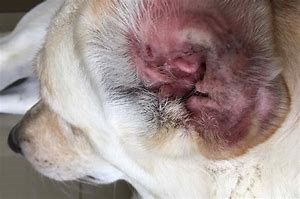
  • Irritated or red skin
  • Inflammation


Dr. Goetz cautions that if part of your dog’s ear feels like a pillow or balloon, he might have an aural hematoma. Essentially, the dog has broken blood vessels underneath the skin, which causes the ear flap to start to fill with blood. If you notice that your dog’s ear flap has started to look inflated or swollen, you should take them to your veterinarian right away. They will examine the ear and decide on an appropriate course of treatment.


If you notice any of this in your dog’s ears, then it is time to make a trip to your veterinarian.


Common Behaviors That Indicate Dog Ear Problems


If your dog is excessively scratching or pawing in the ear, tilting his head or excessively flipping his head, it may also be a sign that he is experiencing discomfort, says Dr. Matthew Goetz, DVM, medical director for the Arizona Animal Welfare League and SPCA in Phoenix.


If your dog is turning in circles, off balance, ataxic or uncoordinated, tripping over objects, or showing signs of vertigo, it could be a sign of a middle or inner ear infection, which is serious and should be treated immediately, says Dr. Klaus Earl Loft, DVM, a veterinary dermatologist at Angell Animal Medical Center in Boston, Massachusetts.


Another sign of a dog ear problem that you may not have expected is if you notice other dogs continually sniffing at your pup’s ear. Dr. Loft suggests that this could also be a sign of ear infections in dogs.


How a Vet Might Treat Your Dog


If your pup’s ears show any signs of infection, or you’ve noticed any of the behaviors that indicate an infection, you need to take your pet to see the vet before trying any type of treatment at home.


“The reason why it’s really important that you go see your veterinarian before you start any medication is that it’s important that the vet be able to look into your dogs’ ear and make sure that the ear drum is still intact. If you have a ruptured ear drum, and you put certain medications in there, it can cause deafness,” says Dr. Goetz.


A vet will perform an ear swab first. The ear swab tests for yeast, bacteria, ear mites and white or red blood cells. If you suspect an ear infection, heading to the vet is important.


A vet might need to send test results to a lab to determine the best treatment, depending on the infection. Most veterinarians can look at the sample through a microscope and determine the cause of acute and external ear infections. Chronic and middle/inner ear infections often need a culture that is then submitted to a lab for evaluation.


Dogs will typically receive antifungal or antibacterial medications, says Dr. Goetz. For a really severe ear infection, Dr. Goetz may prescribe oral antibiotics. If you’re having trouble administering ear medication, Dr. Goetz advises asking your veterinarian about long-lasting ear medications, which can last for 10-14 days.


How Often Should You Clean Dog Ears?


When it comes to cleaning dog ears, Dr. Loft warns pet parents that too much ear cleaning can actually damage your pet’s ears.


“I’m not encouraging people to clean the ear every day and do it as a precautionary, because that sometimes will render the ear more susceptible to maceration [when the skin breaks down after exposure to moisture] or infections,” says Dr. Loft.


Although you shouldn’t be cleaning your dog’s ears often or as a preventative method, there may be instances where you will want to clean them. This should be done after you’ve consulted your vet and discussed treatment.


If your dog is prone to ear infections, you may want to consider cleaning his ears weekly or monthly. You will also want to take extra precaution if you take your dog swimming or submerge his ears during a bath. Try drying them out afterwards or even cleaning them, since moisture in the ear can cause infection. Most veterinary recommended ear cleaners contain a safe drying agent which allows residual water to evaporate, which lessens the risk of infection after swimming or bathing.


How to Clean Dog Ears


According to Dr. Loft, “It’s best to stay away from harsh products like alcohol, vinegar or peroxide, which can make a bubbly sound inside the ear and scare your dog.” To clean your dog’s ear, you should always use an ear cleaner that is made specifically for dogs.


Never use cotton swabs on or in your pet’s ears for any reason. This can lead to serious injury and a trip to the emergency vet.


Here are the steps:


  1. Dr. Loft recommends holding the bottle over the ear canal and gently squeezing the solution into the ear. He advises not putting the bottle or tip in the ear directly.
  2. You then massage the base of your dog’s ear to loosen up the debris within the ear
  3. Let your dog shake their head. By shaking their head, your dog is bringing the softened wax and debris to the front of the ear canal, which makes it easier for you to clean away.
  4. Use a large cotton ball to wipe away all the wax and debris. Be gentle when wiping inside your pup’s ears. The skin within the ear is very sensitive and can be injured if you continually wipe at it.


Chronic Dog Ear Infections


Goetz says having your dog’s ear infections treated early is important for ear health. This is especially crucial for chronic ear infections.


Some chronic infections are so bad that surgical removal of the ear canal is the only option left for pain control—total ear canal ablation (TECA) surgery.


“If you have chronic ear infections that go untreated, you’re definitely going to be predisposed to having hearing loss earlier in life,” says Goetz.


Diane, animal communicator and holistic healer for pets highly recommends a product called Canine Ear spray by Dr. Melissa Shelton that will help reduce ear infections on your dog if used regularly.  Many of my clients have had great success with regular use. Here is the info about the product below:


Ingredients:  Fractionated Coconut Oil, Water, Grain Alcohol, Essential Oils of Copaiba (Copaifera officinalis) , Lavender (Lavendula angustifolia), Lemongrass (Cymbopogon flexuosus), Melaleuca alternifolia, Citronella (Cymbopogon nardus), Clove (Syzygium aromaticum), Helichrysum (H. italicum), Rosemary (Rosmarinus officinalis Verbenone Chemotype), Lemon (Citrus limon), Frankincense (Boswellia carterii)Canine Ear Spray is intended as a spray to be used with a variety of ear conditions in dogs.  Essential oils contained within this product exhibit anti-parasitic, anti-fungal, anti-bacterial, anti-tumoral, and anti-inflammatory properties.  In our veterinary hospital, the use of this spray has proven incredibly beneficial for dogs with chronic ear conditions, and especially those that are resistant to many traditional drugs and antibiotics.  Many of our patients were near surgical removal of the ear canal (Total Ear Canal Ablation or TECA surgery) prior to starting on the Canine Ear Spray.  In clinical use, we see great comfort with the use of the spray and also vast improvements in infection, swelling, and pigmentation.  A major benefit to a spray such as this – is that is actually supports a healthy immune system, instead of shutting the immune system off – as in the case with steroid use.

There are many factors that may contribute to your dog’s chronic, recurrent, or first time ear condition.  Please read more about other changes you can make in your dog’s lifestyle that will help you to combat chronic ear infections and allergies.

Directions for Use:

Shake well before each use.  Spray 1-3 pumps into the ear(s), once to twice a day.  You are not trying to saturate the ear canal or drip the solution into the ear canal directly.  Coating the outer surface of the ear and upper part of the exposed ear canal, will result in the “traveling” of this solution to deeper parts of the ear.  Monitor the ear tissues for any signs of irritation, and stop use if noted.  Generally this recipe is used for 2 weeks or longer.  Work with your veterinarian to determine frequency and length of use, based on response and recheck ear smear results.

This recipe has been used long term, for several months at a time or more when needed.  However, if irritation occurs, please discontinue use.  Although this new formulation of the Canine Ear Spray rarely creates irritations, if it does occur, placing Fractionated Coconut Oil into the ear and onto any irritated surfaces will help decrease any issues.  Fractionated Coconut Oil is safe for use in the ear – however we do not recommend filling the entire ear canal with it.

If your dog is very resistant to having a “spray” in the ear, you can spray the product onto your fingers and wipe gently into the ear and ear canal.


To order

http://www.animaleo.info/canine-ear-spray.html


Chronic vomiting in cats

Chronic vomiting in cats

By Dr. Karen Shaw Becker

Chronic vomiting in cats is unfortunately so common that many pet parents and even some veterinarians view it as “normal” behavior. However, in my professional opinion, chronic vomiting, even in kitties with hairballs, is a sign something’s wrong and needs to be investigated. After all, big cats in the wild don’t routinely vomit.

Wild cats also don’t have hairball issues, which is why I believe recurrent hairballs in housecats is also a sign that something’s amiss. Other common causes of persistent vomiting in cats include a poor diet, food intolerances, eating too fast and too much time in between meals.

Other causes include enzyme deficiencies, gastrointestinal (GI) problems that result in hairballs, toxin ingestion and underlying medical conditions like kidney disease and GI cancer.

Problem: Hairballs

If your kitty is vomiting hairballs, you’ll see cylindrical wads of hair and debris, probably some undigested bits of food, and usually a little phlegm to hold the disgusting little mess together.

Long-haired cats and cats who are really into grooming themselves — and often all the other cats (and dogs, and even people) in the house — typically have more hairball issues than normal. Cats eating dry food don’t get enough moisture in their diet, so their organs tend not to function as efficiently as they should. And unlike dogs, kitties don’t make up the deficiency by drinking lots of water, so they often end up chronically mildly dehydrated.

A GI tract that is moisture-depleted is less able to transport a hairball than the digestive tract of a well-hydrated cat eating a species-appropriate diet. Cats in the wild pass hair in their feces on a regular basis. Felines have tiny bristles on their tongues and are designed to process swallowed hair. Recurrent hairballs are abnormal.

What to do: Brush your cat and feed a moisture-rich diet. To help prevent your cat from swallowing so much hair that it forms hairballs in his GI tract, you’ll need to brush him regularly. If he’s grooming everyone in a multi-cat household, you’ll also need to brush the other kitties.

If your cat is eating exclusively dry food and you can’t or aren’t willing to switch to a different diet, I recommend adding bone broth to his dry food and a bit of fiber to each meal, or a petroleum-free hairball remedy, or even a dab of coconut oil on his front paw. I also recommend fiber and coconut oil together. Kibble fed cats definitely need additional GI lubrication to help ingested hair pass through the digestive tract.

Problem: An Underlying Medical Condition

Many cats today have inflammatory bowel disease (IBD), or irritable bowel syndrome (IBS), which causes intermittent vomiting. IBD can progress to GI lymphoma in cats, which is another reason that chronic vomiting in any kitty should be investigated medically.

In addition to lymphoma, other types of GI cancers can also cause vomiting, as can metabolic disorders like hyperthyroidism, which is a very common disease diagnosed in older kitties. Organ disease or a malfunction of the organs of detoxification, including the liver and the kidneys, will also cause vomiting.

What to do: Make an appointment with your veterinarian. Your vet should first rule out all potential medical reasons for vomiting, for example kidney failure, liver failure, hyperthyroidism or GI cancer.

If all those problems are ruled out and your veterinarian is concerned about potential IBD or IBS, I recommend submitting a blood sample to the GI lab at Texas A&M University for a functional GI test. That test can determine if your cat is dealing with malabsorption and maldigestion, or a disease of the small intestine or pancreas.

Many cats have a reduced number of hairballs and vomiting episodes when their unbalanced microbiome is addressed by switching to a species-appropriate diet, or at a minimum, have probiotics added to their food.

Problem: Poor-Quality Cat Food

Cats fed processed diets containing rendered ingredients may vomit due to poor-quality, biologically inappropriate ingredients. Rendered ingredients that wind up in pet food are leftovers from the human food industry, and can include animal pieces and parts like bird feathers, snouts, beaks, eyes, hooves and nails.

These are very low-quality ingredients with low-to-no bioavailability that are difficult for cats to digest, which can cause GI upset. Cats tend to have upper GI issues, so they vomit. Dogs typically have lower GI issues, and are more apt to develop diarrhea.

Since the introduction of processed pet food, many cats have been fed diets that are not species-appropriate, which has led to the development of food intolerances and allergies — a very common reason for intermittent vomiting over a period of months or years.

If your kitty is at a healthy weight with a normal energy level, but just throws up occasionally, food sensitivity could be the culprit. Food sensitivities develop when the same foods are fed over and over, which happens a lot with cats because they get addicted to certain foods and refuse to eat anything else.

Feeding the same type of protein, even if it’s excellent human-grade quality, can over time create GI inflammation and food sensitivities. So it’s not just about feeding good-quality protein, but also switching proteins frequently. I recommend transitioning cats with GI upset to human-grade cat food (which unfortunately can be very difficult to find), and then to a fresh food diet.

What to do: Upgrade your cat’s diet. I prefer a raw diet for cats who will eat it, but even gently cooked fresh food is a huge improvement over processed pet food. I also recommend rotating proteins every three to four months to avoid hypersensitivity reactions.

If you believe your cat may have a food hypersensitivity or allergy, I recommend Dr. Jean Dodd’s Nutriscan saliva test, which can provide help in choosing a diet that’s less reactive for your kitty. The good news is I’ve found that correcting food sensitivities, removing noxious or unnecessary ingredients from a cat’s diet, as well as transitioning to a species-appropriate, fresh food, natural diet eliminates most of the common causes of vomiting in cats.

If you feed your cat treats, be sure to offer only high-quality treats. You don’t want to spend money upgrading your kitty’s diet and then feed junky treats that can create GI inflammation and vomiting. So if you feed treats, it’s important to offer the highest quality you can afford. Or better yet, make homemade cat treats.

In store-bought treats, you should look carefully at the label and avoid anything containing propylene glycol, FD&C red #4, ethoxyquin, chemical dyes, emulsifiers, surfactants and other questionable ingredients. All those additives, preservatives and other chemicals can cause GI inflammation and vomiting.

It’s also important to note that contrary to what many people think, cats don’t need milk. Animals are only suited to digest and process milk from their own species. Drinking the milk of a different species past weaning can cause or exacerbate GI inflammation. If your cat can’t tolerate cow’s milk, it can cause vomiting, so if you’re giving him milk, I recommend you stop offering it.

Problem: Enzyme Deficiencies

Sometimes a kitty’s pancreas doesn’t produce enough digestive enzymes, such as lipase, protease and amylase, which can result in acute or chronic pancreatitis. Pancreatitis (inflammation of the pancreas), is very common in cats, and even if there are no other obvious symptoms, can be an underlying cause of intermittent vomiting.

What to do: Supplement with digestive enzymes. Cats evolved to eat an entirely fresh food diet, primarily mice, which is a very rich source of digestive enzymes that is entirely missing from processed cat food. That’s why I recommend adding a digestive enzyme to your cat’s diet.

If your kitty’s pancreas is producing adequate enzymes, adding additional enzymes to her food won’t cause any problems. However, if her pancreas is not secreting sufficient enzymes, supplementing ensures she’ll have what her body needs to process her food. Providing a high-quality digestive enzyme can help reduce vomiting as well as the potential for pancreatitis.

Problem: Speed Eating

Another very common reason cats throw up is from eating too fast. Your cat’s esophagus is horizontal and flat. Everything he eats has to travel horizontally before it moves into the stomach.

In cats with a tendency to wolf their meals, the food can back up in the esophagus and push against the lower esophageal sphincter. This can result in regurgitation of part or all of the meal, undigested, within moments of swallowing. This seems to be a special problem in multi-cat households in which all the kitties are fed in the same area at the same time, which can spark competition.

There’s usually at least one gobbler in the group, and when the food bowls hit the floor, he scarfs his own meal in a flash and then visits everyone else’s bowl to see about leftovers. He’s such a little glutton that he often ends up returning all that hastily eaten food to the floor.

What to do: Provide separate eating areas in multi-cat households. If you have a scarfer in the house, you need to feed your kitties in separate areas so they can’t see or hear the others eat. It’s best if you can close the door behind each cat, because it won’t take long for your gobbler to figure out where the rest of the bowls are if he can still get to them.

Give them about 20 minutes of solitude to eat their food slowly and uninterrupted, then remove the bowls. This may slow down your gobbler, reduce or eliminate the vomiting, and keep him from getting fat. It also allows your slower-eating kitties to relax while they dine.

If you have just one cat but she’s a gobbler, you may need to split her meals into smaller portions and feed her more often so the food doesn’t come right back up. You can also use a mini-muffin tin to slow her down. Just put a bit of food in each individual muffin cup. Moving from cup to cup will naturally slow her down.

If you don’t own a mini muffin tin, you can also try spreading the food out over a large cookie or baking sheet. If you prefer something more high-tech, there are slow-feed bowls you can purchase that provide essentially the same benefit.

Problem: Too Much Time Between Meals

Cats fed on a regular schedule, for example, at 7:00 AM and 5:00 PM each day, tend to start looking for their meal an hour or so earlier because their bodies know it’s getting to be that time.

Around the same time, your cat’s stomach begins releasing digestive substances like hydrochloric acid, gastric juices and bile in anticipation of the upcoming meal. If you’re late with her meal, she may throw up a white foamy liquid mixed with a bit of yellow bile.

This is because the digestive substances irritate the lining of the stomach when there’s nothing in there for them to work on, so your cat’s body gets rid of some of the acid to prevent further irritation.

What to do: Offer a pre-meal snack. If this scenario is occurring with your cat, give her a little something to snack on before you feed her, like a treat or a small bite of her meal. This will give her stomach juices something to digest and should alleviate the vomiting.

Problem: Toxin Ingestion

Rarely, poisoning can also be the cause of acute vomiting in kitties. It’s rare, but it happens. If you have a cat who is otherwise healthy, especially an indoor-outdoor kitty, and he suddenly starts vomiting, you should be concerned he has ingested something toxic.

Even if your cat is indoors only, unfortunately, many types of houseplants are poisonous for cats — and many cats like to sample houseplants. It’s important to make sure you’re not bringing anything into your home that could potentially poison your feline family member.

It’s important to note that since cats are designed to eat fresh food, they’ll nibble on anything fresh in your house if they’re not provided a fresh food diet. Since felines don’t have a biological requirement for plants, it’s a good bet most house-plant sampling cats are trying to supplement a processed diet with living foods.

What to do: Offer safe greens to your cat, and safely store all household chemicals out of reach. If you have kitties that like to snack on your houseplants, I recommend providing them roughage that is more palatable and safer than houseplants. You can do this in the form of cat grass, which is wheatgrass, or by offering fresh sunflower sprouts.

Any pesticides, herbicides or household cleaners that are stamped “call poison control” need to be safely stored out of the way of cats. You should assume that any cleaner you’re using in your house will ultimately be ingested by your cat, because kitties lay on surfaces, and they’re fastidious groomers.

All your household cleaners should be cat-friendly. I can’t emphasize enough that if you are still using traditional toxic household cleaners, if you have cats, one of the best gifts you can give them is to switch to nontoxic household cleaners.


What Causes Fatty Tumors In Dogs?

What Causes Fatty Tumors In Dogs?


Toxic Overload

Allopathic medicine is baffled by the cause of fatty tumors in dogs, usually attributing them to random chance, age and genetics. While age and genetics can contribute to the formation of lipomas, there’s something else that needs attention …

Toxins.

The build-up of toxins is often overlooked by mainstream veterinary medicine. From a holistic perspective, when lipomas form it’s a sign that the body is congested and energy isn’t flowing like it should. Toxins and fat get trapped and walled off by the body’s immune system as it pushes contaminants to the outside in an effort to protect and sustain internal organ function.

Your dog’s lymphatic system consists of a network of lymph ducts, nodes and vessels that transport lymphatic fluids to the bloodstream. A major player in the body’s immune function, the lymph system delivers nutrients to its cells while removing wastes.

When your dog’s elimination systems become congested and slow down, this stagnation can lead to blocked circulation causing lipomas and other chronic diseases. This build-up of wastes is sometimes referred to as a dog’s “toxic load.”

So where do these toxins come from? Your dog’s every day environment. Toxins can include:

·         Vaccines

·         Environmental contaminants like glyphosphates, pesticides and herbicides

·         Water contaminates like chlorine and fluoride

·         Heavy metals

·         Pharmaceuticals

·         Flea and tick medications

·         Grooming products like chemically laden shampoos

[Related: How can you minimize your dog’s exposure to toxins? Here are some tips]

Diet

Another contributing factor to toxic load is diet. Everything you feed your dog either contributes to disease or fights it. The cleaner his diet, the less your dog’s body needs to process it.

When your dog eats, his organs (liver, gallbladder and pancreas) decide how to react. This means they either release the enzymes needed to break down and assimilate nutrients or assume the body is under attack and issue an immune response. This leads to inflammation and slow digestive motility resulting in food staying in the digestive tract too long.

When foods aren’t properly broken down, it can result in the formation of toxins which can lead to a vicious cycle of stagnation and chronic inflammatory conditions.

Too Much Fat?

One of the problems about fatty tumors in dogs is the belief that too much fat equals fatty tumor formation. This isn’t true if the body is breaking down the fats.

It’s actually the type of fat that’s the problem, like the rancid and oxidized oils found in kibble. Some examples are rendered animal fat, vegetable oil and GMO soy and canola oils. Sadly, canola oils can be found even in higher end and “all natural” treats.

Your dog’s body sees these undigested oils as immune attackers and the body goes into defense mode, protecting itself by depositing and walling off fat mixed with toxins in the form of a lipoma.

If you suspect your dog isn’t breaking down his food properly, make sure he’s getting clean filtered water, pre and probiotics and digestive enzymes daily.  If you’re a kibble feeder, consider moving your dog to a fresh food diet.

When traditional raw isn’t in your realm of possibility, options like commercial raw food, dehydrated and freeze-dried dog foods are available. You can also home cook for your dogs to add variety, especially if you have senior dogs.

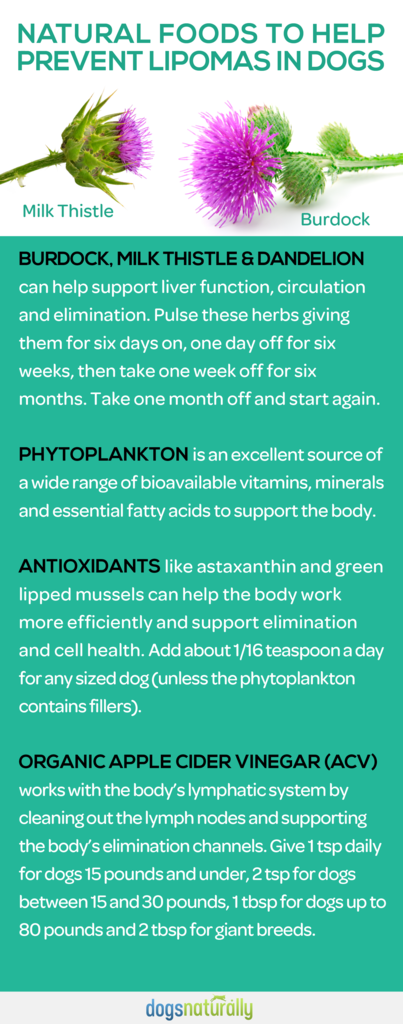
There are also some natural foods that you can add to your dog’s food to help prevent lipomas. Here are some of my favorites:

·         Add a basic regimen of burdock, milk thistle and dandelion can help support liver function, circulation and elimination. Pulse these herbs giving them for six days on, one day off for six weeks, then take one week off for six months. Take one month off and start again.

·         Phytoplankton is an excellent source of a wide range of bioavailable vitamins, minerals and essential fatty acids.

·         Antioxidants like vitamin C and amino acids can help the body work more efficiently and support elimination and cell health.

·         Organic apple cider vinegar (ACV) can be a powerful ally in the prevention and treatment of lipomas. ACV assists in liver detoxification as it stimulates circulation and energy flow. ACV works with the body’s lymphatic system by cleaning out the lymph nodes and supporting the body’s elimination channels. Give 1 tsp daily for dogs 15 pounds and under, 2 tsp for dogs between 15 and 30 pounds, 1 tbsp for dogs up to 80 pounds and 2 tbsp for giant breeds.

Movement Is A Must

Circulation is the key to the continuous elimination of toxins from the body. Since the lymphatic system doesn’t have a pump like the circulatory system, (the heart) it needs movement to efficiently work. Chiropractic care, acupuncture and acupressure help support energy flow but don’t forget about walking! The average American dog gets less than 15 minutes of exercises per day. That also means 15 minutes or less of breathing fresh air.

For any dog with lipomas or prone to forming fatty tumors, walking and fresh air are a must.

One of the best things you can do for yourself and your dog to stay healthy is walking outside. The simple movement helps circulate energy throughout the body and keep the lymphatic system moving as well as stimulate motility in the digestive system.


6 Herbs To Help Shrink Fatty Tumors In Dogs

Along with exercise, herbal remedies can help the body expel toxins, support the liver, kidney, and digestive systems and shrink and eliminate fatty tumors.

1. Chamomile (Matricaria chamomilla) and dandelion (Taraxacum officinale). These bitter herbs can help break down fats in the body by stimulating the digestive system. Dandelion and chamomile help clear heat (inflammation) from the body and decrease stagnation of fluids and energy. Dandelion increases circulation by thinning fluids and supports the linings of the gut by decreasing permeability. It stimulates the release of bile by the gallbladder to help digest fats. Dandelion is a potent lipoma fighter due to its ability to facilitate the removal of toxins through the kidneys and liver.

·         You can add dandelions to your dog’s diet or use a tincture of dandelion giving 1/2 drop of tincture for every pound of weight twice daily. Chamomile makes an effective infusion (a tea steeped 20-30 minutes) added to your dog’s food. Add 1 Tablespoon for every 30 pounds of body weight.

2. Burdock root (Arctium lappa) supports the lymphatic system, the liver and the kidneys. Burdock root combined with milk thistle (Silybum marianum) is an excellent way to help the body rid itself of pharmaceuticals and move heat through the liver. Like dandelion, burdock root helps the gall bladder release bile to support the digestion of fats. Burdock root is cooling to any inflammatory condition of the liver and digestive system.

·         Give as a tincture, 5 drops for every 30 pounds twice a day.

3. Chickweed (Stellaria media) moves fluids through the body and brings down inflammations throughout the entire system. It clears toxins out of the tissues with the help of the kidneys and liver. Used internally and externally, Chickweed helps dissolve lipomas and break up clumped fatty tissue. Diuretic in nature, it helps export toxins through the kidneys especially when combined with a lymphatic stimulant like cleavers (Galium aparine).

·         Give as a tincture, 5 drops for every 30 pounds twice a day.

4. Self-Heal (Prunella vulgaris) is an herb often overlooked for preventing and treating tumors. Like dandelion, self-heal is common in yards and treated like a weed. A superlative lymphatic herb moving fluids in and out of tissues downward through the kidneys. Self-heal removes heat in the liver moving stagnant fluids and improving circulation.  It is safe to use internally and externally to redistribute and break up fatty tissue.

·         Give as a tincture, 1/2 drop of tincture for every pound of weight twice daily.

5. Turmeric (Curcuma longa) a popular anti-inflammatory increases blood flow with its warming nature. It improves digestion and soothes intestinal muscles while protecting the liver as well as stimulating bile secretions from the gallbladder. Turmeric should be used cautiously with dogs that can’t control their body temperature.

·         Give 150 mg per 30 pounds of your dog’s weight twice a day.

6. Violet (Viola odorata) is one of the best lipoma herbs and it’s also safe for long-term use. Violets help dissolve hard and soft accumulations in the body through the lymphatic system. They’re cooling so they work especially well for hot conditions like fatty tumors. You can use violets internally and externally. Herbalist Juliette de Bairacli Levy used violet leaf as a poultice along with an infusion of the leaf and flower to remove any type of cyst or lipoma.

·         To make an infusion, use 1 tsp for small dogs in a half-cup of water and divide into morning and evening doses. For medium dogs use 1 tbsp and 2 tbsp for large dogs. As a tincture, give 5 drops for every 30 pounds twice a day.

Note: General guidelines for using these dosages is giving them for six days on, one day off for six weeks, then take one week off for six months. Take one month off and start again.

[Related: Do you know how to use herbs for pain relief for your dog? Here’s how]

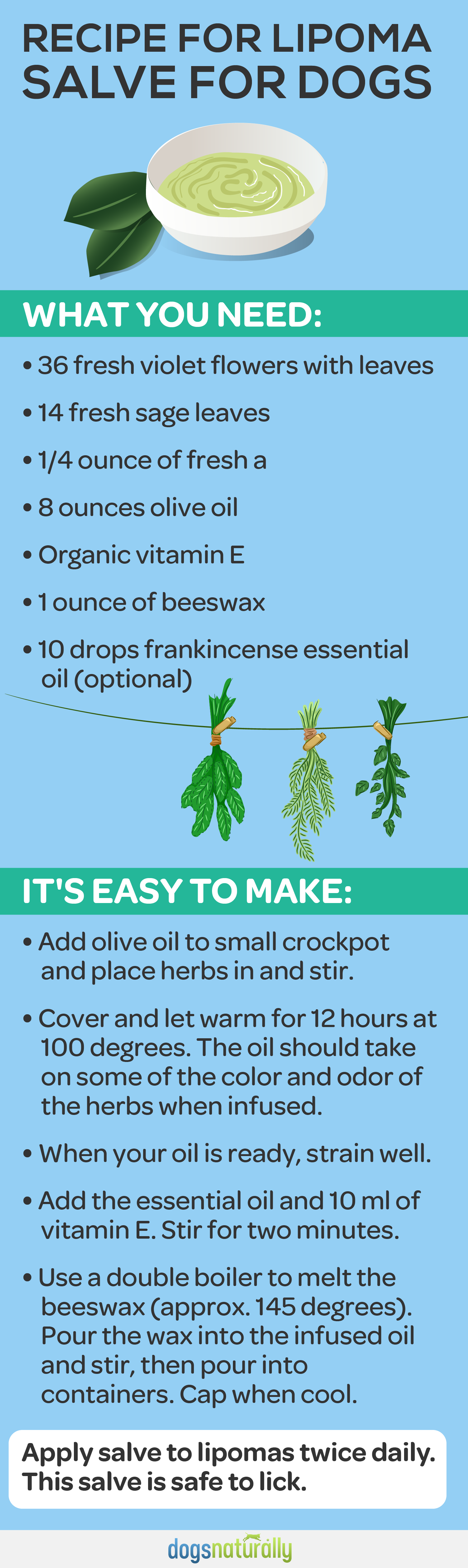
Easy Lipoma Salve Recipe

What you need:

·         36 fresh violet flowers with leaves

·         14 fresh sage leaves

·         1/4 ounce of fresh chickweed

·         8 ounces olive oil

·         Organic vitamin E

·         1 ounce of beeswax

·         10 drops frankincense essential oil (optional)

It’s easy to make:

·         Add olive oil to small crockpot and place herbs in and stir.

·         Cover and let warm for 12 hours at 100 degrees. The oil should take on some of the color and odor of the herbs when infused.

·         When your oil is ready, pour through a strainer into a glass pitcher.

·         Add the essential oil and 10 ml of vitamin E and stir for two minutes.

·         When you’re ready to make your salve, use a double boiler to melt the beeswax (approx. 145 degrees). Pour the wax into the infused oil and stir, then pour into containers and cap when cool.

Apply salve to lipomas twice daily. This salve is safe to lick. I like to make large batches of this salve in the springtime when fresh herbs are available.

Using herbal remedies with patience and consistency can support the body’s elimination channels. Recovery from lipomas is individual and some dogs will respond at a faster pace than others.

The goal is to slowly dissolve fatty tumors so the body isn’t overwhelmed with toxins and the herbs and the other healing methods I’ve mentioned in this article as well as homeopathy offer effective ways to support the body’s elimination channels while working to get the body back in balance. Working with these methods will not show success quickly but with patience and consistency, you’ll see these fatty lumps get smaller and in many cases disappear.


Mistakes Which Can Make Your Dog Depressed

Mistakes Which Can Make Your Dog Depressed

By Dr. Karen Shaw Becker and comments by Diane Weinmann
Science hasn’t figured out yet whether dogs suffer from depression in the same way people do. They certainly experience mood and behavior changes, but those changes are usually temporary and traceable to a recent event in the dog’s life. For example, perhaps the kiddos just headed back to school after a summer spent swimming and playing with their dog, and she misses having them around. Or maybe you’ve just added a puppy to the family and your older dog is feeling left out.

Dogs who suffer the loss of a family member (human or pet) often go through a grieving period. And of course many dogs abandoned at shelters suffer a period of sadness and uncertainty.  Grief relief in the form of a custom made bach flower essence can help the transition period of loss.  Contact Diane at Dianefortheloveofanimals@yahoo.com for a custom treatment bottle to deal with grief for yourself or your pet.

The problem with diagnosing clinical depression (which is different from short-lived episodes of depressed behavior) is that even in humans, there’s no biological test to identify the condition. Medical doctors take note of symptoms and what the patient tells them about their feelings to arrive at a diagnosis.

Many people who cannot talk and hear pets must rely on their powers of observation to determine if a canine companion is feeling down in the dumps. Generally speaking, when a vet or veterinary behaviorist or animal communicator describes a patient as depressed, the dog is displaying a change in normal behavior.

6 Reasons Dogs Get Depressed

1. She’s dealing with an undiagnosed medical problem

If your dog’s behavior changes, even if you suspect you know why, it’s always a good idea to check in with your veterinarian. Many changes in behavior symptomatic of depression, including lack of appetite, potty accidents in the house, sleeping more than usual, reluctance to exercise and sudden aggressive behavior in a dog who has never shown aggression, can also be signs of any number of underlying medical conditions.

2. He’s feeling ignored

A healthy dog who is feeling depressed may lose interest in eating or playing, become destructive, have accidents in the house or stop running to greet you when you come through the door. Like a sleepy, sluggish dog, a depressed pooch often just needs more quality time with his human.

Get into the habit of spending an uninterrupted hour with your dog each day engaging in physical pursuits, grooming rituals, training exercises and good old tummy rubs. It will lighten both your moods!

3. She’s not getting enough exercise

Sadly, some dogs become socially inhibited when they aren’t getting enough exercise and playtime. This can take the form of a decrease in interaction with other family members, or choosing to isolate themselves in their crate or another room. If your normally happy dog suddenly isn’t, consider the possibility that she needs more exercise.

Most dogs need much more physical activity than their owners realize. Your dog should be getting an absolute minimum of 20 minutes of sustained heart-thumping exercise three times a week. Thirty minutes is better than 20, and six or seven days a week is better than three.

Minimum exercise requirements prevent muscle atrophy, but don’t necessarily build muscle mass, strengthen tendons and ligaments, hone balance and proprioception, or enhance cardiovascular fitness, which is why more is always better. If you can provide your dog daily walks as well as additional daily training sessions to meet your other exercise goals, even better!

4. He’s suffered the loss of a human family member or pet

It’s not unusual for dogs to grieve the loss of a person or animal friend they are bonded with. According to the late Dr. Sophia Yin, a veterinarian and applied animal behavior specialist, dogs feel the same basic emotions humans do, including grief, fear, anger, happiness, sadness and even possessiveness.

When a dog is mourning a loss, depression is common. Signs of depression in dogs mimic those in people — sleeping more than normal, moving more slowly, eating less and showing a limited interest in playing.

If your dog seems depressed at the loss of a person or animal he was close to, engage him in activities he enjoys, such as a walk, a game of fetch or a trip to the dog park. It’s really a matter of distracting him with things he enjoys until sufficient time has passed and he’s no longer looking around every corner for the one who is now absent from his life.

And it’s best not to expect a quick fix. It can take from a few weeks to a few months before your dog’s depressed mood begins to lift.  Again as mentioned above,  a custom Bach Flower essences treatment bottle can help your pet deal with their grief holistically.

5. Her favorite human is depressed

Your dog is very observant of your emotional state, which she can detect by observing the tone of your voice, your body language and other subtle clues, including your pheromones (how you smell). The way you move, speak and behave all send subtle signals to your dog that indicate your mood.

For example, when you’re in a situation that’s stressful to your dog, such as at your veterinarian’s office, she’ll look to you to help her calm down. If, however, you seem tense and nervous, she’ll likely become even more anxious. Your dog is extremely intuitive; so if you’re feeling blue, don’t be surprised if she seems depressed as well.

6. He’s being subjected to punitive behavior training

Dogs who are punished for undesirable behavior instead of being rewarded for positive behavior may stop interacting with their owners in an attempt to avoid punishment. They adopt a depressive state of mind called “learned helplessness” because they feel powerless to avoid negative situations.

I can’t stress strongly enough the importance of positive reinforcement behavior training, not only to help your dog become a good canine citizen, but also to preserve and protect the close and priceless bond you share with him.

5 Tips for Helping a Depressed Dog

1. Keep daily routines as consistent as possible. Pets do best when they know what to expect from one day to the next. Try to keep mealtimes, exercise, walks, playtime, grooming, bedtime and other daily activities on a consistent schedule. Exercise is a powerful tool to help increase your pooch’s endorphins, or “feel good” hormones. Lots of walks (with plenty of opportunities to sniff) can be a powerful mood enhancer.

2. Keep your dog’s diet and mealtimes the same and spice up what’s on the menu. It’s important to continue to offer him the same food he’s used to, at the same time each day, but if you find your dog isn’t interested in eating much, consider offering a yummy knucklebone for dessert, or make a tasty treat for training time that he hasn’t had before.

Store what he doesn’t eat in the fridge, and offer it to him again at his next regularly scheduled mealtime. Use his hunger to help him get his appetite back by resisting the urge to entice him with unhealthy food toppers.

3. Be careful not to inadvertently reward your dog’s depression. It’s only natural to want to comfort your sad pet, but unfortunately, giving attention to a dog who is displaying an undesirable behavior can reinforce the behavior. Obviously the last thing you want to do is reward a lack of appetite, inactivity or other types of depressed behavior in your dog. Instead, you want to help her over the hump.

A better idea is to try to distract her with healthy, fun activities that provide opportunities for positive behavior reinforcement. This can be a walk, short training sessions, a game of fetch, nose work or offering her a food puzzle toy or recreational bone.

4. Give it time. Your dog’s depression may take a few days or even weeks to blow over, but eventually most pets return to their normal lively selves. If at any point you feel your pet is suffering unnecessarily or there is something more going on than a case of the blues, I recommend discussing the situation with your vet or a veterinary behaviorist.

5. Use natural remedies, if needed. There are some excellent homeopathic and Bach flower remedies that can be easily administered to your depressed dog until you see an emotional shift for the better. Some of my favorites include homeopathic Ignatia, several Bach flower remedies including Mustard and Honeysuckle, and Green Hope Farm Grief and Loss.  Custom treatment bottles for your unique situation can be obtained from Diane Weinmann at Dianefortheloveofanimals@yahoo.com.


Homeopathic remedies for Colic

by Dr. Dan Moore DVM


 It’s difficult for me to discuss any health issue without the mention of a few homeopathic remedies for colic is no exception and overload or excess of anything can often be helped with a remedy called nux- vomica It is my first response favorite remedy for anything related and is great at what I call energetically detoxing as well as for other health issues such as post-anesthesia.


It’s actually also good for people who have eaten or drank too much!


 Most homeopathic remedies are available as liquids but I prefer the little BB sized pellets packaged in lipstick tubes most health food stores and some big grocery change chains can carry them potencies of 30C or 30X are generally used by most people unless they are trained otherwise.


 I am totally convinced that homeopathic remedies can never hurt and can only help in any case we never leave home without a remedy box and there’s always one at the barn.


 Another remedy to consider is Colocynthis should the nux not give comfort it is especially helpful for cramps that would be characterized by kicking and rolling and looking or biting at the belly. Additionally, Colchicum especially if neither of the other remedies seem to work.


 I usually give nux a few times every 10 minutes or so followed by Colocynthis and Colchicum  rotating each at 10 minute intervals.  I also try to prevent rolling by walking the horse because this process often takes his mind off the pain and gets the gut moving


There ain’t no bugs on me!

Essential oils can assist animals with their healing using energetic vibration and the essence of the natural product. They can help bring balance and healing through their sense of smell which is the most receptive of the pet’s systems.

The oil stimulates the olfactory system which in turn sends a signal to the brain regarding the specific oil. The brain then activates the pet’s natural ability to begin the healing process.
Aromatherapy does not cure conditions, but helps the body to find a natural way to cure itself and to improve immune response.s the body to find a natural way to cure itself and improve immune response.

the body to find a natural way to cure itself and improve immune response.

AWAY

Ingredients:  Essential Oils of Eucalyptus citriodora, Catnip, Citronella, Lemon Tea Tree, White Cypress

Away was created for many purposes, but all are encompassed in the word “Away”.  Bugs go “Away”, smells go “Away”, and stale energy can also go “Away”!  I put it on my dog any time we are going into the woods or open field for a walk.Petting Technique
The petting technique is a way to apply the oils to your pet. This technique is well tolerated by almost every form of animal. The technique can be modified for small rodents, amphibians, or animals that may be difficult to handle, simply by having the oils absorbed into your hands, and then “cupping” and holding the animal within your hands.

Petting Technique
The petting technique is a way to apply the oils to your pet. This technique is well tolerated by almost every form of animal. The technique can be modified for small rodents, amphibians, or animals that may be difficult to handle, simply by having the oils absorbed into your hands, and then “cupping” and holding the animal within your hands.

s the body to find a natural way to cure itself and improve immune response.

Dogs:  Away can also be applied to most dogs topically using the “Petting Technique.”  Place 1-3 drops into your hands, rub them together until a light coating remains, then pet onto areas of need.  For insect repellent; rubbing down the legs, neck, shoulders, and back are good locations to concentrate on.  I especially focus on the “ankle” area of my dogs, since ticks will often contact this area first, as they start to climb up the legs.

Cats:  Diffusion of Away in a water-based diffuser is also recommended for cat households.  Away is wonderful for eliminating pet odors from the household, and litter box areas.

http://www.animaleo.info/order-animaleo.html

Petting Technique
The petting technique is a way to apply the oils to your pet. This technique is well tolerated by almost every form of animal. The technique can be modified for small rodents, amphibians, or animals that may be difficult to handle, simply by having the oils absorbed into your hands, and then “cupping” and holding the animal within your hands.

Away product sheet

Kidney Disease and your Cat

By Dr. Karen Shaw Becker and comments by Diane Weinmann


Feline expert Dr. Lisa Pierson, founder of the fabulous website CatInfo.org. Dr. Lisa graduated from the University of California, Davis veterinary school in 1984. For the last 15 years, she has focused almost exclusively on feline nutrition and feline medicine. Her passion is trying to help prevent some of the diseases we see in kitties today (e.g., diabetes and urethral obstructions) by feeding them properly.

“My biggest goal, as you well know,” says Dr. Lisa, “is to get people to stop feeding dry food to cats due to the water depletion, which can lead to urethral obstruction, and the carbohydrates, which make cats more susceptible to diabetes.”

Feline Kidney Disease May Be Linked to a Particular Vaccine

The no. 1 problem veterinarians see in cats today is kidney disease, and so I wanted to talk with Dr. Lisa about the best way to feed kitties with kidney disease. When I was in veterinary school 20 years ago, I was told 3 out of 4 cats will die of kidney disease. No reason was given. We were told, “There’s nothing you can do. Cats are predisposed to die of kidney failure.” We were taught how to identify the problem, but not what causes it. I asked Dr. Lisa for her thoughts on what’s behind the epidemic of kidney disease in cats.

“That’s a fabulous question I wish I had the answer to,” she replied. “We do know that a well-respected researcher, Dr. Michael Lappin at Colorado State University, has established a possible link between feline kidney disease and the feline viral rhinotracheitis, calicivirus and panleukopenia (FVRCP) vaccine, which is grown in feline kidney cell cultures.”

“We really want to be very careful not to over-vaccinate cats,” Dr. Pierson continued, “because they can possibly set up an autoimmune type of reaction to their own kidney cells. Having said that, my own cats still developed kidney disease.

I assure you they were not over-vaccinated. They got vaccinated as kittens. They passed away between 18 and 20 years of age. They were never vaccinated again after their kitten shots, yet they still got kidney disease. They were not on dry food. They were on a water-rich diet. So the short answer to your question is, ‘I don’t know, but I wish I did.'”

An important point to make here is that as Dr. Lisa’s situation demonstrates, we can do everything right and our cats may still acquire a debilitating disease, including kidney disease. Many parents of sick cats say, “I don’t know what I’ve done wrong.” Often, they’ve done nothing wrong. Even in optimal environments, cats can and do get sick.

How Many Vaccines Do Indoor-Only Cats Require?

I usually recommend, for people with indoor-only cats, that they skip all vaccines. If you know your cat will never step foot outside and no other cats will be brought into the home, there’s virtually no risk of exposure to the diseases we vaccinate against. I asked Dr. Lisa what she thinks about not vaccinating indoor-only cats at all.

“While I’m definitely against over-vaccinating, I always give at least one vaccine when the kitten is at least 16 weeks of age,” Dr. Lisa says. “I’ve seen enough cats die from panleukopenia to make me uncomfortable with the thought of no vaccines at all.

We do take these cats to veterinary clinics and many people do wear shoes in their homes so there is not zero exposure. I would at least vaccinate once. I differ with you on this issue. I’d be worried about leaving them completely unvaccinated for panleukopenia.

I had five cats two years ago. I lost four out of my five cats in the last two years. They were between 18 and 20 years of age. They received [two] FVRCP vaccines as kittens with the last dose administered when they were at least 16 weeks of age. A couple of them may have received another FVRCP vaccine a year later but no FVRCP vaccine was administered after that. None had been vaccinated since they were kittens or maybe a year old.

On their last day with me, I ran panleukopenia titers to measure the antibody levels in their bloodstream. Antibodies aren’t the only things that fight disease, of course, but for all intents and purposes, all the cats’ titers indicated they were protected against panleukopenia.

My mom’s cat is 20 years old. I don’t think I vaccinated him after age 5. I ran a couple of panleukopenia titers on him when he was 18 and again just recently and the titers were at a level that immunologists feel is a protective level against this disease.

My own cats are 100 percent indoor-only. They get vaccinated with FVRCP when they’re kittens, with the last vaccine at about 16 weeks of age when the maternal antibodies should be gone. I do not administer the FVRCP vaccine again.”

So Dr. Lisa does vaccinate her indoor-only cats, but minimally. Historically my indoor cats also received one vaccine at 16 weeks. But I think if I get another kitten who will live strictly indoors, I’ll probably not vaccinate at all. I’ll probably do none, since his or her exposure will be none, in my opinion.

‘Protein Is NOT the Enemy of the Cat Kidney!’

Next I asked Dr. Lisa for her thoughts on what cat parents can do early on in their pet’s life to try to prevent kidney disease.

“I really don’t know anything concrete,” she explained. “Some people believe a water-depleted diet of dry food can harm the kidneys, but I don’t know if there’s any research to support that theory.”

Often, cats fed exclusively dry food have super-concentrated urine because their kidneys are trying to preserve water for the body. “Does that cause or lend itself to kidney disease?” asks Dr. Lisa. “I really don’t know.”

“I feed a water-rich diet. I feed a species-appropriate highprotein/moderate fat/zero carb diet. With regard to how protein affects the kidneys, it’s important to understand protein is not the enemy of the cat kidney. Protein doesn’t cause kidney disease. It doesn’t exacerbate kidney disease. It is not the enemy of the kidney.

If there’s one take-home message I want to get across, it’s ‘Please stop vilifying protein!’ I would not feed any of the protein-restricted, so-called ‘prescription’ diets to any cat in my care. There are always better options.”

The Problem With Protein-Restricted Diets for Cats

Back in 1994, Dr. Delmar Finco proved cats will die of hypoproteinemia (insufficient protein) long before they die of kidney disease. I can’t figure out why, if we’ve had research available for over two decades, there’s still this pervasive idea in veterinary medicine that we should restrict protein. I asked Dr. Lisa why she thinks veterinarians still have not recognized that limiting protein is a really bad idea.

“We have to ask why this idea of protein-restricted diets came to be in the first place,” she replied. “Why did our profession glom onto the idea that protein is the bad guy? When we eat protein, our bodies break it down. We use what we need and our bodies produce BUN (blood urea nitrogen, or urea), which is a waste product of protein metabolism.

The more protein we eat, the higher the BUN load. If the kidneys are efficient and healthy, they filter the BUN out into the urine. When the kidneys become less efficient filtration organs, the BUN rises in the bloodstream. So the powers that be decided, ‘BUN comes from dietary protein. Let’s just minimize dietary protein.’

I do not have a problem with cutting back a little bit (say, from 60 or 70 percent to 40 percent) but I do not agree with feeding cats only 20 percent of their calories from protein.”

My thought is that if you’re feeding a poor-quality, rendered, dehydrated protein that conceivably consists of indigestible animal parts such as hooves and nails, it may negatively affect the kidneys long term. High-quality, human-grade, bioavailable protein — which is what cats in the wild eat — should have little to no negative impact on organ systems. If it did, felines wouldn’t have survived as a species.

However, we’ve preached the low-protein thing for so long, to switch viewpoints now could dramatically impact the billion-dollar pet food industry. I fear it’s possible we’ve gone too far to turn back.

“I’m still hopeful,” says Dr. Lisa. “I spoke with a colleague the other day. She had just attended a seminar at which someone said, ‘We’ve got to stop protein-starving these cats.’ And I thought to myself, ‘Hallelujah!’ I’ve been preaching this for 15 years, as have you.”

What Amount of Protein in a Cat’s Diet Is the Right Amount?

“I want to give your listeners some numbers to chew on,” says Dr. Lisa. “If you look at metabolizable energy, meaning the calories from protein, fat and carbs, they have to add up to 100 percent. Hill’s k/d, Purina NF, Royal Canin are prescription diets that restrict protein to a level between 20 [to] 27 percent of calories. A cat’s natural diet is about 60 to 70 percent.

When I formulate recipes for my chronic kidney disease (CKD) cats, or I recommend over-the-counter diets, using my proteins, fats, carbs, phosphorus chart at CatInfo.org, I recommend a nice happy medium of 40 percent calories from protein. I don’t think cats truly need the 60 to 70 percent they find in the wild. All you are doing is adding to the BUN load. I don’t think it’s necessary.

I’ve had fabulous results over the last 15 years feeding thousands of CKD cats right around 40 percent protein, and less than 10 percent carbs. My homemade diets have zero carbs. That means they have 60 percent fat, because it has to add up to 100 percent.

So those are some numbers I want to share with your listeners. In the vast majority of patients, I find that 40 percent protein calories will support muscle mass and the immune system without unnecessarily overloading the BUN bucket that the kidney then has to deal with.

Of course, more BUN is generated with a 40 percent protein diet than one with 20 percent protein. That is obvious. However, all disease processes are a trade-off and one has to remember a very basic equation: 6 ounces of a 20 percent protein diet = 3 ounces of a 40 percent protein diet in terms of grams of protein ingested — assuming the same caloric and water density.

Sure, a cat can meet their protein requirements on a diet that has only 20 percent of the calories from protein, IF they eat enough of it. But what happens when a cat on a protein-restricted diets starts to eat less? The answer is they will become protein malnourished and the diet needs to be more protein dense to make up for the decrease in volume intake.”

When You Lower the Protein in a Cat’s Diet, You Should Raise the Fat Content, Not the Carbohydrate Content

Interestingly, Dr. Lisa’s 60 percent fat figure lines up with the recommended fat intake in ketogenic diets. I think we need to educate pet parents that fat is an excellent source of energy, and it’s also dogs’ and cats’ evolutionary source of energy.

“In the wild, cats eat about 60 to 70 percent protein, 0 to 2 percent carbs, and then 10 to 30 or 40 percent fat,” says Dr. Lisa. “So the 60 percent fat for a CKD diet can end up being double what their natural diet is if we want to hold back on the protein a bit and NOT overload them with carbohydrates.

Research on fat content in cat diets indicates that some cats with GI problems such as chronic vomiting, chronic diarrhea, inflammatory bowel disease, and pancreatitis don’t do well on a 60 percent fat diet, but it’s rare.

Felines are obligate carnivores. They’re designed to eat protein, fat and no carbs. When pet food producers formulate prescription diets, k/d for example, with lower protein, they have to raise the percentage of either fat or carbs to get to 100 percent. Hill’s raises the carbohydrates, which makes the diet even more species-inappropriate.

Royal Canin actually chooses to raise the fat and keep the carbs down a bit. That’s much more species-appropriate. If you’re going to lower protein at all, don’t raise the carbohydrates. Raise the fat. Cats deal with fat more efficiently than carbohydrates.”

A Brilliant Tip for Monitoring Your Cat’s Kidney Function at Home

In my experience, many people with CKD cats are frustrated that the condition wasn’t discovered earlier. That’s why I like to be proactive and perform annual bloodwork to identify subtle changes that can occur in cats’ bodies long before they start showing symptoms of kidney dysfunction. I asked Dr. Lisa what she feels is the best age to start doing annual bloodwork on cats.

“That’s a great question, but I’m going to turn it around,” she replied. “What I check, because it’s usually the first thing to head south with respect to kidney disease, is urine specific gravity. I have a spoon sitting next to all my litterboxes — the boxes are uncovered because I’m not a fan of covered or hooded litterboxes — and a little syringe.

For around $50 to $70, you can buy a refractometer — this information is actually on my urinary tract diseases page towards the bottom under the video showing how to obtain a free-catch urine sample at home. There’s a link there to a refractometer. I put a couple of drops of urine from the syringe on it and look at urine specific gravity, which is a measure of the concentrating ability of the kidneys.

All my cats go in for annual bloodwork anyway, no matter their age. Of course, if they’re sick, I’ll take them in more frequently. Bottom line is, I do annual bloodwork, but I’m checking their urine specific gravity frequently ([four to six] times a year) when they get to be 10 years of age or if I notice them drinking more than usual. My cats are very used to spoons stuck under their butt!

The SDMA test — which is the proprietary IDEXX urine test that is supposedly better than creatinine levels in detecting early kidney disease — can also be run. However, measuring urine specific gravity can be done at home for no cost other than a refractometer and it may be even better than the SDMA, in some cases, to help us recognize kidney disease earlier.

Urine specific gravity parameters:1.040 and above shows a normal urine concentrating ability of the kidneys; 1.012 is rock bottom. When you start getting 1.030, 1.025, 1.020, you may want to take your cat in to check the BUN, the creatinine, the phosphorus and the potassium.”

That’s really great advice. Cheap, easy, and you’re not stressing out your cat. Just follow kitty with your spoon when he goes into his litterbox, stick spoon under butt, collect a bit of urine, pull it into your syringe and put a couple drops in your refractometer. You can start when he’s a kitten, or as soon as you bring a new adult cat home. You can continue to do it proactively throughout their lives. It’s a brilliant tip!

The Kidney Disease Staging System (IRIS) Has Serious Flaws

“I also suggest setting up an Excel spreadsheet for all the BUN, creatinine, phosphorus, potassium and urine specific gravity results,” Dr. Lisa continues. “Those are my big five: BUN, creatinine, phosphorus, potassium and urine specific gravity. I’ve charted all my cats, which brings me to the IRIS staging system.

The IRIS staging system — IRIS stands for International Renal Interest Society — establishes parameters for judging the severity of kidney disease. When the creatinine is over X, they’re stage one. When it’s over Y, they’re stage two. There are four stages.

I personally strongly dislike this system. I think it’s far too strict. Creatinine over 1.6 is deemed a problem. I disagree with that. My own cat, Robbie, has had a creatinine in the low [2s] for the past 10 years.

He’s 17 years of age, and his kidneys are still fine. I think the IRIS staging system alarms people unnecessarily, and too early. I think it’s too strict. I just want readers and your listeners to understand that when your vet says stage 1 kidney failure it’s a case of maybe, or maybe not.”

This is very true. There’s a whole lot of doom and gloom around IRIS staging. I think it can actually lead to premature euthanasia, when the fact is there is much that can be done for these cats, sometimes for years to come.

“The cats are put on a prescription renal diet, which I strongly dislike,” says Dr. Lisa. “It’s also one of the reasons I have a problem with the SDMA test, because these cats are being put on protein-restricted diets even earlier. I think to myself, ‘Great. We’ve got an early marker, but now these 6-, 7-, 8-year-old cats are being put on protein-restricted diets, which makes me cringe.'”

Why Supplementing With Fish Oil/Omega-3s Is so Important

So let’s say we have a cat for which we regularly check urine specific gravity, and all is well until kitty turns 9 or 10 and his number dips to, say, 1.025. We take him in for an SDMA test, and the vet determines he’s in the beginning stages of renal disease. I asked Dr. Lisa how she would proceed at that point.

“First of all, let’s hope the cat has been off of dry food all his life, or at least as soon as his owner learned dry food is not a very healthy diet for a cat,” she says. “So let’s hope he’s on a water-rich diet.

Regarding urine specific gravity: Picture a sieve in your kitchen, and the holes of that sieve are getting bigger and bigger and bigger. When urine specific gravity drops, it means the kidneys are leaking more and more water. They’re unable to save water for the body.

There’s nothing that frustrates me more than to see cat owners leave their vet’s office with a bag of fluids under one arm and a bag of dry food under the other arm. They’ve been told to feed a water-depleted diet and then stick a needle in their cat’s back to put water into him. That’s pretty nonsensical

The sensible approach? Step one, provide a water-rich diet. Step two, the diet should be low in phosphorus. Step three, supplement with omega-3 fatty acids— fish oil, fish oil, fish oil. When we do post-mortems on these cats, we see nephritis. ‘Neph-‘ means kidney, ‘-itis’ means inflammation.

We know that fish oil and omega-3 fatty acids, specifically eicosapentaenoic acid (EPA) plus docosahexaenoic acid (DHA), are anti-inflammatory. There was a meta-data study done that looked back at all the individual CKD studies that were done, and the researchers discovered that cats getting high amounts of fish oil seemed to live the longest.

Now, I’m not that bright, but two plus two might equal four in this case, where we have an inflammatory process. Fish oil happens to have anti-inflammatory properties, so it stands to reason that fish oil may slow the progression of kidney disease.

Here’s my goal: one capsule per cat per day. One regular strength capsule should have about 300 milligrams of combined EPA plus DHA. They’ve done safety studies to show that 600 milligrams of combined EPA plus DHA per cat per day is safe.

Fish oil can cause bleeding problems in some patients, which is why if you’ve gone in for surgery in recent years you’ve probably been told to stop taking aspirin and also fish oil ahead of time because they have anti-clotting properties. But 300 milligrams of combined EPA plus DHA is safe.”

“We also treat with potassium as needed,” explains Dr. Lisa, “because sometimes these cats get very hypokalemic, meaning they have low blood potassium levels.

One of the reasons I don’t like the prescription renal diets is because toward the end stage, CKD cats can get hyperkalemic, meaning they have too much potassium in the blood. All the renal diets are fortified with potassium, so they end up compounding the problem of hyperkalemia and are detrimental to the patient.”

Switching a Dry Food-Addicted Cat to a Moisture-Rich Diet

“I really love homemade diets,” says Dr. Lisa. “I’m a big fan. The recipes I formulate mimic the prescription diets in that they include plenty of B vitamins and antioxidants, plenty of fish oil, and I can adjust the potassium as needed based on the patient’s blood levels.

They’re low in phosphorus. They contain a moderate amount of high-quality proteins versus the prescription diets, [which] are more protein-restricted and often have very [poor-quality] (low biological value) sources of protein (e.g., [Brewers’] rice). My patients thrive on these homemade diets.”

I’m of course a huge proponent of homemade diets as well. The number one complaint I get from clients, though, is their cat won’t it eat.

“First of all, there is no need to make diet ‘all or nothing,'” says Dr. Lisa. “Many cats will not eat a diet of 100 percent homemade and always need a bit of commercial canned food mixed in to make it more flavorful. It’s fine to mix commercial with homemade. Some homemade is better than nothing.

That said, I find that people give up far too easily when trying to get their cats to eat a new diet. People shouldn’t get discouraged as quickly as they do. They have to roll up their sleeves, work at it, and be patient. Also, the key issue is change the diet before your cat is really sick. No sick cat wants to try something new.

And use your cat’s hunger as your friend. Don’t put the food down, watch them walk away from it, and just give up by putting their old food back down. Make them go 12 hours without food. Make them go 18 hours without food. Get a little tough.

Look at my tips for transitioning a dry food addict. It’s applicable when you need to change any diet. Hunger is your friend, number one. Take the diet they like, 90 percent of it. Mix in 10 percent homemade, then go 80-20 or 70-30. Or do the opposite, take 90 percent of the homemade, start slipping in a little Fancy Feast or Sheba, or whatever you want to feed.

But be patient. Don’t give up. You can actually out-stubborn your cat, but people give up far too easily. It took me three months to get my cats off 100 percent dry food. Some of them had never seen canned food in their entire lives, including my 10-year-old. It took me three months to get them from dry food to canned food.

And then it took me a little bit longer to get them from the canned to the homemade, because the canned tends to be gamier-smelling, and probably a little bit more flavorful.

I love FortiFlora, which is a Purina probiotic. I use it as a flavor enhancer, not as a probiotic. If I were to put that powder on cardboard my cats would eat it! I just use it like salt and pepper, just sprinkle it on their meals. It’s a liver digest. If you’re going to pick something that a cat likes, most cats love liver.

Or you can buy something like Fancy Feast Chicken and Liver or Turkey and Liver, the classic feast, which is kind of my go-to enticement. I try to stay away from fish. I don’t want to create a fish addict. There are other problems with fish. But when you’re trying to transition a cat away from dry food, I don’t mind giving them a little bit of fish, but you’ll have to wean them off it.”

A Word About Fish Versus Fish Oil

For those of you confused as to why we’re recommending fish oil but not fish, I should clarify that our issue with fish as a protein source is that not only are many types of fish contaminated, they are also high in iodine, which can cause hyperthyroidism. Good-quality fish oil supplements don’t contain iodine and are tested for purity and potency, which means they’re screened for heavy metals and PCBs.

Fish oil also doesn’t cause food sensitivities, unlike fish fed as a protein source. Bottom line, fish oil is really in an entirely different category from fish fed as a protein source. It’s protein versus fat, as Dr. Lisa points out. Fish oil is safe and a good source of omega-3 essential fatty acids. However, feeding fish to cats is not recommended.

If Your Cat Has Kidney Disease, Ask Your Vet About Calcitriol

I asked Dr. Lisa what else she would suggest cat parents do to help enhance their kitty’s quality of life, longevity and kidney function.

“You might want to ask your veterinarian about calcitriol,” she answered. “Calcitriol is the active form of vitamin D. One of the jobs of the kidneys is to take the inactive form of vitamin D and activate it. In other words, it makes calcitriol.

The parathyroid gland, not the thyroid gland, but the parathyroid gland, is very intimately involved with calcium and phosphorus balance. It secretes parathyroid hormones (PTH), which can be toxic to the kidneys if it gets too elevated. The off switch for PTH production is calcitriol.

If we don’t have enough calcitriol in our body, there’s nothing to tell the parathyroid gland, ‘Shut up. Be quiet. Stop making so much PTH.’ The research on cats is scant and a little iffy. But calcitriol proved to be beneficial in a study of dogs.

There are some feline specialists who are big proponents of calcitriol for cats, and I personally think it’s a ‘can’t hurt, may help’ issue. Your viewers should ask their vets about administering calcitriol to their CKD cats. It’s recommended early in the disease. If the dosage is adhered to properly, I think it’s a can’t-hurt-may-help.

When we first tried the calcitriol we got some hypercalcemia early on because we were giving it every day and at higher doses than we currently use. We now give it twice a week instead. And for the record, I don’t recheck CKD patients to death. I feed a high[-]quality, low-phosphorus diet with plenty of antioxidants and anti-inflammatories. I use calcitriol and call it a day. Beyond that, the chips are going to fall where they may.

I find that most of my clients get frantic, asking ‘What can I do, what can I do, what can I do?’ The truth is, not much. Cats’ kidney disease will progress as it’s going to progress. So again, don’t over-vaccinate. Feed a water-rich diet. Sit back and relax with your cat. Don’t keep fretting about it because the kidneys are going to do what they’re going to do on their own timetable. There’s really nothing we can do about it beyond the basics I’ve just discussed.”

If Your Cat Is Diagnosed With Kidney Disease, There’s No Need to Panic

I am always impressed with how resilient cats’ bodies are. Even in a state of decompensation (organ failure) they keep going and going and going. Often the BUN is very high and they’re still eating and physically look fine. If we’re chasing a number or making decisions based on a lab result, I think it’s easy to become so overwhelmed that it takes away from our quality of life. It’s possible to fret so much about the future that we don’t enjoy the time we have left with our pet.

“I’m glad you brought that up,” says Dr. Lisa. “I find that subcutaneous fluids are used far too early in the disease process. I’m also not a fan of Azodyl. I don’t feel it works. I don’t feel there’s any benefit. I don’t want to see cats being pilled with these humongous capsules.

You know me, I’m typically not much of a supplement person. I’m a ‘Give them good food, give them fresh water, love them and don’t keep poking a needle in their back until it’s really time’ sort of person.”

Dr. Lisa brings up a great point. I love Azodyl, but I do not believe we should be shoving anything down a cat’s throat. I think if your kitties will eat supplements like Azodyl or probiotics on their own, awesome. But the last thing you want to do is chase a cat, especially a sick cat around the house and have her hide under the bed and fear you.

This is completely disruptive to your relationship with your kitty, and even more important, it significantly increases her stress response, which will end her life sooner than anything else. There’s no reason we should be cramming anything down a cat’s throat. If they take supplements voluntarily, great. If they don’t, don’t force it.

“Absolutely,” says Dr. Lisa. “I have an article on pilling cats on my website. I hate pilling cats. I may be a real weeny about it, but I just hate it. And again, be careful about starting fluids too early. Cats can live a long time with CKD.

My cats got kidney disease at 14 and 16. They both died four years later, but not from kidney disease. They died from cancer. And I want to also mention that just because your cat has a low urine specific gravity, it isn’t the kiss of death. Cats whose kidneys have stopped fully concentrating the urine can live three, four, five years and longer and quite often die from something else. If your cat starts to get a low urine specific gravity number, there’s no reason to panic.”

Honoring Your Sick Cat’s Wishes

All of Dr. Lisa’s suggestions today have been common sense and very respectful of the feline body and spirit. But I think, most importantly, they should provide peace of mind for those of you watching or reading who are worried about your cat and kidney disease.

Sometimes the more information we gather — even though we want to understand everything we can so we can make good decisions — can create profound stress. It can also cause vets to give their clients with CKD cats long lists of tasks to perform that can be daunting. Often, we’re making decisions not on how the cat looks or seems to feel, but on a theoretical disease progression that may or may not occur. We end up creating stress for everyone in the family, including the cat, and it doesn’t have to be that way.

“Exactly,” Dr. Lisa says. “When I go on VIN (the Veterinary Information Network), colleagues are asking each other questions like, ‘When do you start fluids?’ The answer more often than not is something like, ‘When the creatinine is 3,’ which is a very arbitrary approach to a procedure that is stressful for both the cat and the owner.

Instead, you need to look at the patient. Are they eating a water-rich diet? Are they eating plenty of it? Do they have any vomiting or diarrhea? Are they bright and alert? You don’t just start fluids arbitrarily at a number. You look at the patient.

It’s also important to understand that plain water (no sodium, chloride, etc.) taken in orally is healthier for a body then the fluids that are administered subcutaneously. Therefore, we should do whatever we can to increase oral water intake before starting sub Q fluids. This means feeding no dry food and adding some extra water to canned food or a homemade diet.”

I think if an animal is saying, “Don’t do that to me,” we need to not do it to them. That’s one of the hardest things to convince clients of, that “This will be a really nice approach IF our patient participates.” But if we have a cat who chooses not to participate, we need to respect that. I think we need to encourage our clients to be more respectful and push less. “I agree 100 percent,” says Dr. Lisa. “My Toby, I thought he’d be very easy to give fluids to. I tried it, and he hated it, so I didn’t force him to accept the procedure.”

Sometimes we end up making decisions to not treat the patient, because they have decided they don’t want to be treated. That’s called honoring our patients’ wishes. To honor their wishes, why not ask your cat?  Contact an animal communicator like Diane Weinmann at dianefortheloveofanimals@yahoo.com to discover your cat’s wishes.

“Quality over quantity,” Dr. Lisa agrees. “Because let’s face it, we want everybody, human and animal, to live forever. There’s a selfish component to it, because you don’t want to lose them. But don’t be selfish with your cats. Listen to them.”

I very much appreciate Dr. Lisa Pierson making time for me today and sharing her tips, tricks, ideas, thoughts and amazing information with us. Be sure to visit her website, CatInfo.org, which provides a wealth of extremely helpful and practical information about your cat’s health.

 

Homeopathy for Eye Disorders

By Todd Cooney, DVM, CVH | February 9, 2017


We say the eyes are the window to the soul. One can gauge an individual’s health with a thorough gaze into this amazing organ. Eyes are also a window to the outside environment, and crucial to most animal species. Eye disorders are a regular part of veterinary practice, and homeopaths treat eye symptoms as part of the individual’s total symptom picture, or totality. Let’s consider how homeopathy is useful in treating some of the most common eye disorders seen in practice today, after this quick overview of homeopathy basics.

HOMEOPATHY 101

Homeopathic treatment is based on true natural laws of healing, which do not change over time. Homeopaths study the same textbooks used over 200 years ago, and practice according to the same principles outlined by the old masters of this healing art. Three basic laws undergird all of homeopathy:

1.    The Law of Similars states that any substance that produces symptoms in a healthy individual can cure the same symptoms in disease. For example, the watery nasal and ocular discharge of hay fever or a cold may respond well to Allium cepa, a remedy made from onions, because sliced raw onions cause similar symptoms (it may help any individual with watery ocular discharge).

Another good example is parvo virus in puppies, with its characteristic nausea, vomiting, and foul liquid diarrhea, often helped by Arsenicum album, which causes the same syndrome in healthy individuals. Symptoms are the body’s attempt to restore homeostasis, or balance, and the correct homeopathic remedy supports this process, rather than opposing it. Opposing symptoms or surgery often lead to suppression, forcing the natural disease deeper into the body.

2.    Hering’s Law states that disease tends to develop in a certain direction, and leave in the opposite direction. All cure starts from within and moves out, from the head down, and in reverse order as the symptoms appeared, or were suppressed. This translates to symptoms moving from more vital to less vital organs, from the interior to exterior of the body (think skin), and from the top down (or head to tail in animals) as healing occurs. For the eye, a cure would move from a cataract to an ocular discharge. This direction of cure is universal, and happens regardless of the type of medicine doing the curing.

3.    The Law of Dilution/Potentization states that repeated dilutions and succussions (forceable mixing) of remedies results in a greater strength of effect. A 6c potency is diluted 1:100 six times and succussed each time; the much more potent 200c is diluted 1:100 a total of 200 times with succussions. Quantum physics is shedding some light on possible explanations for this phenomenon, as is nanotechnology (see the two-part article “Homeopathy: a 200-year-old nanomedicine” by Shelly Epstein, DVM, CVH and Iris Bell, MD in the Summer and Fall 2013 issues of IVC Journal), and clinical experience confirms this law.

OPHTHALMOLOGY AND HOMEOPATHY

A noted human homeopathic ophthalmologist, Edward Kondrot MD, CCH, DHt (healingtheeye.com), believes that the largest cause of all eye disease in people is suppression caused by modern medicines and treatment methods. I feel this also translates to our animal patients.1 The following are a few contributing factors:

·        Antibiotics for conjunctivitis

·        Treatment of chronic blepharitis

·        Steroid eye drops and ointments

·        Cataract surgery

·        Laser surgery and injections for retinal disease

These “opposite” treatments cause the disease to go deeper into the body, resulting in more serious eye problems. A good example are the “side effects” listed for steroid eye drops, which are actually the result of suppression – corneal ulcers, infections, cataracts, increased intraocular pressure, to name a few. This is also true in our veterinary patients, as antibiotic/steroid medications are the first line of allopathic treatments for most eye conditions seen in practice. How do we address some common veterinary ophthalmological conditions with homeopathy?

1.    Conjunctivitis

Up to 90% of eye cases have some degree of this inflammatory symptom. Many clients present an animal with eye discharge and want an antibiotic, fearing infection. However, true infections are rare. The ocular organs given the body a route of cleansing and detoxification (lacrimal system), along with the saliva, lungs, skin, gastrointestinal tract, urine, etc.

The most common causes of conjunctivitis are poor diet, toxin accumulation from vaccinations (vaccinosis), GI imbalance, and possibly tight dog collars (harnesses improve many health conditions). Bathing the eye with soothing solutions can be taught to clients.

·        Saline: ¼ teaspoon salt in one cup clean, distilled water.

·        In severe cases, add up to ten drops per cup of water of one of the following herbal tinctures: goldenseal, euphrasia, calendula or hypericum.

Here are a few of the most useful homeopathic medicines for conjunctivitis, with common indications (the symptoms of the patient should be present in the remedy, but not all the remedy symptoms need to be present in the patient):

·        Aconitum – sudden onset; intense fear; exposure to bright sunlight/ snow reflection or cold weather; early stages with intense painful inflammation; profuse watery discharge; bloodshot eyes

·        Allium cepa – minor irritations; watery, bland tears

·        Apis mellifica – swelling is key; chemosis; thick, sticky discharge; thirstlessness

·        Argentum nitricum – young animals; copious yellow/green discharge

·        Arsenicum album – yellow/watery discharge; chilly, restless, thirsty patient

·        Belladonna – sudden, intense inflammation; dry eyes; dilated pupils

·        Euphrasia – also known as “eyebright”; acrid tears leaving a stain; chronicity

·        Mercurius (vivus or solubilis) – acrid, thin discharge; pus in anterior chamber; green nasal discharge; irritable nature; sensitive to hot and cold

·        Pulsatilla – bland yellow discharge; itchy eyes, mild inflammation; resolving upper respiratory infection

·        Rhus toxicodendron – yellow, profuse discharge; intense inflammation; painful; gluey discharge sticking lids together

·        Sulphur – end of upper respiratory infection; acrid discharge; itchy eyes and lids; rubs eyes and face a lot

1.    Corneal ulcers

These are common, and often a sequel to conjunctivitis, ranging in severity from superficial to deep, or even indolent.

·        Euphrasia – a very good remedy for many ulcers; used topically in saline eye wash, or given orally in potency (or both)

·        Aconitum – if the ulcer is very painful, and developed recently

·        Apis, Argentum nitricum, Arsenicum alb., Hepar sulph., Mercurius, Rhus tox., Silicea, Sulphur, Thuya – other remedies to help heal ulcers

·        Silicea or Thuya – to complete healing of stubborn, indolent ulcers

1.    Eye injuries

Scratches, abrasions, lacerations and bruising are some of the most commonly seen injuries. These cases will usually respond very well to the correct remedy, without needing any other treatment. Consider the following:

·        Arnica montana – patient extremely touchy; traumatic injuries of any kind

·        Calcarea sulph. – excellent for splinters or foreign bodies in soft tissue around eye

·        Calendula – used internally or topically

·        Conium – cataract developing after trauma

·        Euphrasia – corneal edema post injury

·        Ledum – bruising; blood pooling under sclera/cornea, in anterior chamber

·        Staphysagria – corneal scratches/lacerations

·        Symphytum – blunt trauma to eye (“Arnica for the eye”)

1.    Entropion

This is a very painful condition, which often requires surgical correction. The following remedies may be helpful in some cases, and even prevent surgery:

·        Borax – patient displays extreme noise sensitivity; fear of falling (avoids going down stairs or panics when picked up)

·        Calcarea carbonica – other developmental problems present; soft, flabby, big-boned patients; slow dentition in history

1.    Ectropion

Many cases can tighten up enough to not need surgery, and involve many of the same remedies listed above, as well as:

·        Calcarea carbonica – if often needed

·        Apis, Argenticum n., Mercury, Sulphur

1.    Cataract

Some cases respond well to homeopathic treatment, especially when the total symptoms shown by the individual are included. Dr. Compton Burnett, a British homeopath in the late 1800s,2 used various remedies, depending on the patient’s symptom totality, and had good success with many cases. He also describes five cured cases in his wonderful book, Fifty Reasons for Being a Homeopath.

Dr. Richard Pitcairn3 lists the following remedies as useful for cataract treatment:  Conium (especially indicated in cataract following eye trauma, and in older patients), Silicea, Pulsatilla, Sulphur and Euphrasia. 

CONCLUSION

The healing responses of many eye cases I’ve treated since I began to practice homeopathy encourage me to use this modality first when presented with eye issues. Eye problems often appear to be isolated from the rest of the body, but must be seen holistically to choose a successful prescription.


Case Studies

1.    Indolent Ulcer in Cat

In November 2012, a specialist diagnosed an herpetic keratitis in the right eye of an 11-year-old Siamese mix named Emma Morse, which had progressed into an indolent ulcer. He recommended surgery to repair it, and dispensed topical and oral antibiotics.

Dr. Jennifer Ramelmeier prescribed Hepar sulphuris calcareum 1M to be given QD on November 17, 18 and 19 because of the severe pain and ulceration.  

On recheck on December 3, the ophthalmologist reported the cat had improved significantly so surgery was no longer needed. A second prescription of one dose of Hepar sulph 10M was administered once, and by January 14 the ulcer was healed.  There was a small milky spot remaining.

2.    Recurrent Uveitis in a Mare

By Stephanie A. Chalmers, DVM, Diplomate ACVD, CVH

Haleakala is a Rocky Mountain Mare. Born in December of 1994, she had been a brood mare before being purchased in September 2005. She had multiple (12) vaccines between October 2005 and May 2007 (at which time her owner stopped vaccinating). She had a hoof abscess in March 2008.

Ocular pain, eyelid swelling and mild scleral injection were noted in the left eye on April 17 of 2008. The local vet made a diagnosis of uveitis and administered Banamine and a topical antibiotic eye ointment. Symptoms recurred on May 25, again in the left eye. This time the vet administered an intravenous steroid and prescribed a topical antibiotic/steroid ointment.

When her owner contacted me on June 9, mild conjunctivitis and squinting were still present in Haleakala’s left eye. She also had early cataract development in the right eye. Her owner described her as a mild-mannered horse, sensitive and responsive when ridden. She liked to be brushed and petted. Though she had been a good mother, she seemed unattached to the other horses on the property.

My assessment was that this was a manifestation of vaccinosis. Drugs temporarily covered up the eye symptoms, but had not resolved the underlying vital force imbalance that continued to generate this symptom.

Silica 30c was prescribed to be given once, based on the symptoms of uveitis, the cataract, the suspected role of vaccination, the history of a hoof abscess and the mildness of Haleakala’s nature. We discontinued the eye ointment.

A complete resolution of her ocular symptoms occurred within one week after administering the single dose of homeopathic medicine. Her owner also noted that her coat looked better.

The uveitis returned in 2010 in the same eye and resolved with one dose of Silicea. The same thing happened again the following year (2011), but the disease never progressed to pathology. During that period, I treated her with Sulphur to resolve a hoof abscess. 

I was unable to continue prescribing to completely cure Haleakala, because the owner decided to treat the mare herself when the eye inflammation recurred in 2013.


1Kondrot, Edward MD, CCH, DHt. (healingtheeye.com)

2Burnett, J. Compton. Cataract: Its nature, causes, prevention, and cure. 1889.

3Pitcairn, R and Hubble, S. Complete Guide to Natural Health for Dogs and Cats