
Vibrational Medicine

Healing Hands using Healing Touch for Animals or Reiki

I use vibrational medicine a lot in my holistic healing practice with animals.  So what exactly is healing on a vibrational level?  I talk about it a lot but I never knew the exact definition of it until I looked it up.  I intrinsically knew what I meant when I talked about healing with crystals, color and sound but when asked to explain it I could not articulate it to my satisfaction.

Vibrational medicine is a term used to describe a wide variety of living remedies. Vibrational medicine incorporates the use of chi energies within living organisms such as plants, gemstones and crystals, water, sunlight, and even the foods we eat. Almost everything we touch and see around us has a living pulse inside of it. We need look no further than the planet we live on to take advantage of its natural vibrational remedies to help us balance the chi energies within our own bodies

Vibrational medicine is a type of energy medicine. Energy medicine is based on vitalism, the metaphysical doctrine that living organisms possess a non-physical inner force or energy that gives them the property of life. This metaphysical force goes by many names: chi or qi (China), prana (India), ki (Japan); Many kinds of alternative therapies or energy medicines are based on a belief that health is determined by the flow of this energy: acupuncture, acupressure, crystal therapy, massage, therapeutic touch (TTouch), reiki, healing touch for animals (HTA), healing with sound and vibration (tuning forks, music and drums), aromatherapy (essential oils)  healing with color or herbs are a few of the better known therapies.

1.  Healing with Crystals and Gemstonescrystals

A shiny rock plucked from the dirt is one of the first treasures I discovered as a small child on my own. Rocks, a natural resource of earth, can be found almost anywhere. We pave our streets with gravel, our beach sands are made from the smallest crystals. We adorn ourselves with gold rings and silver bracelets that are set with colorful gemstones. Whether or not you realize it, within each gemstone and crystal is housed healing properties. Ever wonder why you are attracted to a particular stone and not another? Nature finds a way to get the stones that carry the healing and spiritual properties that are most needed into our hands.  I use all different types of crystals in my healing practice.  I’ve also created critter crystals that hang off collars and halters (horses/cows/goats) to promote wellness with your pets.

2.  Healing with Light and ColorsColor Harmonics

Color is simply a form of visible light, of electromagnetic energy. All the primary colors reflected in the rainbow carry their own unique healing properties. The sun  and moon themselves are wonderful healers! Just imagine what life would be like without sunshine. It has been proven that lack of sunlight contributes to depression for some people. Some of the tools used in color therapy are gemstones, candles, wands, prisms, colored fabrics, bath treatments, and colored eye wear.  Laser therapy is a field of medicine that is being developed more and more in the health care community. I use healing with color using the LumaLight to bring color, healing and balance into a pet’s energy field.  I also use the STS 2  Healing systems which uses red and infared lights to promote healing and wellness.

3.  Healing with Plants and Herbs

All plants (trees, flowers, and even our garden grown foods) have nutritional and/or medicinal properties. The foods we eat have a vibrational energy within them along with their nutritional values. The rite of blessing our food before we eat originated from pagan roots. Thankfulness is offered for the sacrifice the plants give when it is harvested. The Diva Kingdom consists of aromatic herbs used in essential oils and flower essences. Each “Diva” (flower or plant) carries its own unique talent that can be used as a remedy. For example, cherry plum brings mental calmness, clematis is a grounding essence, holly teaches love and acceptance, and so on.  I use Bach Flower essences which are made from 38 different plants and flowers to elicit emotional healing in both people and pets.  I also use essential oils for a variety of healing purposes both physical and emotional.

4.  Healing with the Elements

Our world is comprised four basic elements. These are air, earth, fire, and water. Understanding what each element represents helps us evaluate where our individual strengths and weaknesses are. Healers have found that focusing on the elements and the vibrational energies associated with each of them is helpful when seeking what course of treatments would best address our problems. Approximately seventy percent of the earth’s surface consists of water. This fact alone make water an element awarded our utmost respect. Besides that, our bodies require us to drink water for our basic survival.

5.  Healing with Sound and Music

Sound and musical tones are vibrational healers. Chanting OM is the most basic, primal sound and the origin of all sounds. Without our voices and ears, communication would be limited. Some sounds are not pleasant to listen to (fingernail on the chalkboard, a screeching train wheel, etc.) but many sounds are soothing. Nature offers some of the most healing vibrational tones (babbling brooks, whale songs, wind in the trees, and so on). Sound therapists incorporate a variety of sound tools into their work (drums, tuning forks, singing bowls, and others).  I use tuning forks for both vibrational (touching the fork to a body) and for sound (the actual vibration of the fork when struck against an activator).

So now that we all know what vibrational medicine can do for us, let’s start vibrating! (ha ha ha)

Tuning Fork and Activator

Skin Problems in Dogs

by Marc Abraham BVM&S MRCVS

Article courtesy of Barking Heads Meowing Heads

http://www.barkingheads.co.uk/contact/dog-ticks-skin-46073724

One of the most common reasons for clients bringing their poorly pets in to my clinic is skin problems. Your dog’s skin, including coat and ear canals, is an extremely good indication of overall health. When skin problems occur, your pooch will often tell you by scratching excessively, and if it can reach, chewing and/or licking affected areas.

With our dogs exposed to so many environmental factors 24/7 it’s no surprise that there’s a wide range of skin problem causes, from external parasites (e.g. fleas, ticks), infections, various allergies, metabolic problems, even stress, or indeed any combination of these.

It’s also worth noting that because of this wide range of causes, dogs of all ages and breeds are susceptible to issues involving skin; but young, elderly, immunocompromised, or dogs living in crowded, stressful environments may be more prone than others.

Symptoms

As well as general signs of irritation e.g. scratching, licking or chewing, there can be so many indications – some more obvious than others – that your dog is suffering from skin disease. Scabs, infections, wounds, redness or inflammation, all depend on not only how active is the problem, but also if these signs are secondary to an original (primary) problem, e.g. Golden Retriever ‘hot spots’ (one particular area where itching is intense) found on their necks (below).

All parts of your dog’s skin can be affected; from round, scaly patches on the face and paws, to dry, flaky or otherwise irritated skin elsewhere. Hair loss and bald patches can often be tell-tale signs of allergies, self-mutilation, even hormonal imbalances, with angry rashes on your dog’s underside commonly indicating a reaction to something they’ve come into contact with, e.g. certain grasses, nettles, etc.

The word ‘lesion’ is commonly used by vets when we assess your dog’s skin, and it means that region in a tissue that’s suffered damage through injury or disease. This can mean anything from an abscess draining pus, to any number of variations of swellings, lumps, bumps, even changes in skin color.

Your dog rubbing its face against furniture or carpet can also be a sign so best get anything abnormal checked out ASAP as these conditions can prove extremely challenging to diagnose, expensive to treat, sometimes requiring long courses of antibiotics, washes, etc.

Causesscabies-white-dog-fur-feeling-pain-outdoor-35326213

With so many potential causes of skin disease any of the following may be enough to cause abnormalities with your dog’s skin and should always be thoroughly investigated. Top of the list – and especially when winter central heating’s turned on – must be fleas; bites and droppings from these pesky insects irritate dog’s skin, with some having an allergic response to flea saliva following a bite.


This ‘flea bite hypersensitivity’ is common with affected dogs (above) displaying itchy lesions on the lower back, tail base, and inner thighs – but can also be more generalized – distribution alone is never diagnostic. Always buy flea treatments from your vet, worm your dog regularly, and in severe cases treat your house with a special spray. Seasonal weather changes may also contribute, like with people, to dry, flaky skin as well.

Other parasites, such as ear mites, can also cause irritation resulting in severe ear infections, accompanied by smelly discharge and intense discomfort. Another burrowing mite called Sarcoptes scabei causes sarcoptic mange, resulting in extreme itching and inflammation similar to an allergic response. All require immediate treatment to alleviate symptoms.

Seasonal allergies are common, characterized by all-over scratching, and maybe due to sensitivity to allergens (allergy trigger factors) like pollen, weeds, dust, mites, trees, mold, or grasses. Particularly affected are specific at-risk dogs with defective skin barriers (allowing increased water loss and allergen penetration), and abnormal immune responses. However, some patients may even be genetically predisposed to inflammatory and itchy allergic skin disease e.g. West Highland White Terriers (below), Labradors, German Shepherds, and Shar Peis.

Another cause of skin disease can be food allergies, developed from a range of common ingredients found in dog foods, such as beef, chicken, wheat, corn, or soy. Even fillers and colorings are seen as ‘foreign’ by your dog’s immune system leading to itching and rashes. Adverse food reactions can invite a response from your dog’s immune system (hypersensitivity) or no response (food intolerances, which can include toxins/histamine release).

Frustratingly, hypersensitivity to food allergens is often indistinguishable from hypersensitivity to other (airborne or contact) allergens. So working out which is the cause – from reactions to food or parasites – is often tricky, and requires careful diagnostic work, including ruling out all other diseases causing itching.

And if all that’s not bad enough for your dog, it’s not uncommon for secondary skin infections to accompany skin allergies, usually bacteria or yeast (e.g. Malassezia), taking full advantage of damaged skin, and totally complicating the picture. Multiple treatments to manage both allergy and infection are often now required.

Another condition affecting dogs is ringworm, a highly contagious fungal infection resulting in inflammation, scaly patches, and hair loss. Due to its high potential for spread ringworm also needs to be treated immediately to avoid other pets and people in the household from becoming victims.

Stress or boredom can cause skin disease too. Your dog may lick their skin (especially legs – above) excessively for many reasons. Some will lick as a coping strategy for stress, as well as when not given adequate opportunity for physical or mental stimulation. Metabolic or hormonal problems can also cause changes in skin color, coat consistency, thickness, even distribution.

Finally, certain grooming products e.g. shampoos, can irritate your dog’s skin. Be sure to only use dog-friendly grooming products, and ask your vet if you suspect any products are responsible.

Diagnosisprofessional-vet-doctor-examining-pet-dog-skin-examining-light-29924440

Identifying the many underlying causes of skin disease is not always straightforward, so visit your vet as soon as you notice any abnormality in your dog’s skin or hair, or if they begin to excessively scratch, lick and/or bite areas on their fur.

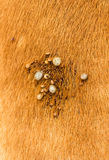
Your vet will obtain a detailed history and perform a thorough physical examination, perhaps even some diagnostic tests in order to identify the cause of symptoms. Tests may include a skin biopsy, skin scrapes, hair plucks and/or coat brushings for flea dirt (feces of fleas – below) or ringworm, microscopic examination of hair and skin for presence of parasites or infection, allergy testing (may recommend diet change), even blood tests to assess your dog’s overall health.

Food allergy diagnosis can usually only be made by response to a novel or ‘hydrolyzed’ protein diet, with treatment by avoiding offending allergens. Diagnosis is based on history, clinical signs, and response to treatment, but other concurrent allergic skin diseases may also need to be addressed as multiple allergies co-existing in one patient is not uncommon.

Once diagnosis is certain, some owners may want to pursue specific testing (intradermal allergy/serological testing) to reveal which allergens are responsible; and is also required for owners wanting to pursue allergen-specific immunotherapy – but is not mandatory – as many forms of treatment are symptomatic and don’t require identification of allergens concerned.

Treatments

As expected with so many causes, there is a wide range of treatments available, including antibiotics, antifungals or anti-itching topical products/medications e.g. shampoos, dips, creams, or spot-on products (to prevent and treat parasites). Shampoos are useful in many cases, and also help treat specific secondary infections, reduce allergen load in the coat, and improve skin barrier function.

Like all disease prevention, a healthy balanced diet is important to help maintain healthy skin and coat e.g. Barking Heads Bad Hair Day. Dietary supplements containing essential fatty acids are extremely useful, reducing skin inflammation, enhancing skin’s role as a barrier; hence very useful in chronic treatment of skin allergies, but can often take a couple of months before positive effects are noticed.

Steroids (e.g. prednisolone) are useful drugs for the short-term management of allergic disease in animals that have seasonal disease or for acute flare ups, producing rapid reductions in itching; with short acting courses being more favorable than long term. Steroids may be dispensed as tablet or topical treatments e.g. ear drops, eye drops, creams, ointments, and sprays.

Most steroids, both ingested orally or absorbed through the skin when applied topically, can lead to side effects, such as eating/drinking more, leading to weight gain. Longer term, every other day tapering therapy is recommended only in patients that cannot be managed using other drugs, with fewer side effects which may include diabetes mellitus, skin thinning, and liver changes.

Sadly, safer antihistamines e.g. piriton, aren’t nearly as potent as steroids, with some animals only responding when multiple drug combinations are trialed – if any response at all. On a positive note side effects from antihistamines are rare, although drowsiness may be seen (which in itself can reduce scratching at night).

Preventiondog scratching

Good management of canine skin disease may involve regular visits to your vet, and is generally divided between treatment of acute flare-ups and managing the chronic disease. All dog owners should try to use natural, dog-friendly hypoallergenic soaps, and shampoos. Regular brushing prevents matting of hair, carefully checking skin, paws, and ears at every grooming session.

Feed a healthy, balanced diet e.g. Barking Heads Bad Hair Day, without fillers or artificial ingredients. Vets may also recommend dietary supplements. Treat for fleas and worms, as well as regularly cleaning and vacuuming your home (remembering to always throw away the bag!) Reduce likelihood of stress try by providing calm living conditions for your dog using artificial pheromone or oral calming natural products if indicated.

Some forms of skin disease can be extremely difficult to cure, with pets often requiring lifelong medication. Despite treatment, most patients still suffer from occasional flare-ups of disease and often have secondary infections which need treatment in addition to allergy management. Occasionally referral to a veterinary skin specialist may be of benefit to discuss multiple treatment options and better control.

Heat Stroke – Recognize the signs in your dog!

Information compliments of Dog’s Naturally Magazine

Hot weather is here and you’re walking along with your 80-pound, long-haired shepherd one warm, sunny afternoon. You’re breaking a bit of a sweat, but you feel just fine in your shorts and tank. But then you look over at Thor, and he’s not looking too good … his eyes are glazed, he’s panting heavily and he’s starting to pull back on the leash.

“But, it’s not that hot,” you say to yourself. “What is up with Thor?”

Thor is probably on his way to having heatstroke, which means he is quickly losing his ability to regulate his body temperature because of an overabundance of heat. Dogs don’t sweat the way we do – they only have sweat glands in their nose and pads of their feet. And their only real recourse when they are overheating is to pant, which sometimes isn’t enough. Add to that the fact that their bodies are covered in fur and their paws are usually in direct contact with hot concrete or asphalt … and well, it’s easy to see how they can get much hotter than we can – fast.

And since heatstroke can quickly lead to irreversible damage to major organs like the kidneys, liver, heart, brain – and can even cause death – it’s important to know the signs.

How Do I Know If My Dog Has Heatstroke?

Normally, a dog’s body temperature is somewhere between 100.5 to 102.5 degrees Fahrenheit, slightly higher than for humans. A dog will start to experience heatstroke at over 105 degrees. At around 106 to 108 degrees, organ damage can occur. Always keep a rectal thermometer handy for your dog and check his temperature if you suspect heatstroke.

Other signs to look out for include:

🔹Excessive panting

🔹Excessive thirst

🔹Glazed eyes

🔹Hyperventilation

🔹Increased salivation

🔹Dry gums that are pale or grayish

🔹Bright or dark red tongue or gums

🔹Rapid or erratic pulse

🔹Weakness

🔹Staggering

🔹Confusion

🔹Inattention

🔹Vomiting

🔹Diarrhea

🔹Rectal bleeding

🔹Collapse

If the overheating isn’t stopped, your dog’s breathing will slow or stop, and he can have seizures or fall into a coma. Obviously, we don’t want any of that to happen. So, what should you do if you think your dog has heatstroke?

My Dog Has Heatstroke, What Do I Do?

Whenever the weather gets warms, it’s a good idea to pay special attention to how your dog is doing. And know your dog: Breeds with “flat faces” like Pugs and Boxers, elderly dogs, puppies and sick dogs are at even greater risk of overheating. Things progress quickly when it comes to heatstroke, so as soon as you detect a problem, act quickly.

Get him into shade.

Since heat is the obvious problem, the goal is to get him out of it and away from direct sunlight.

Apply cool water.

Get water on his inner thighs and stomach where there are more large blood vessels, and on the pads of his feet. Use running water via faucet or hose and avoid submerging your dog in a tub or pool because this could cool him too fast and cause other problems like cardiac arrest and bloat. Also, avoid cold water or ice because these will cause the blood vessels to constrict, slowing blood flow and the cooling process.

Air him out.

To help cool your dog, you want to make sure the water you’re putting on him can evaporate. To that end, you’ll want to avoid covering him up with a wet towel or blanket because rather than allowing the water to evaporate, this will create a sauna effect – which you don’t want. Keep him out of enclosed areas like a kennel; instead, keep him near flowing air like from a fan or air conditioner.

I witnessed this in my own dog just yesterday!  He was panting, a lot! I immediately put him into my family room which is freezing cold with the air conditioner going and I put the ceiling fan on him.

Keep him moving.

Encourage your dog to stand or walk slowly while he’s cooling down, so that his cooled blood can circulate throughout his body.

Give him small amounts of cool – not cold – water.

If he gulps down too much water too fast, it can cause vomiting or bloating.  With my dog,  I put some water from the refrigerator into his bowl to “freshen it up” and make it cool.

Give him some chicken or beef broth

…if he doesn’t want water, but avoid human performance drinks.

Get him to the vet.

Once your dog has started to cool down, you can stop your efforts and take him to his vet right away. You don’t want to continue trying to cool down your dog for too long or you’ll risk him getting hypothermia. Your dog will need a veterinary exam even if he seems fine because there may be underlying damage to his organs that you can’t see. Even if he seems normal, the effects of heatstroke can continue for 48 to 72 hours following the initial heatstroke. According to William Grant DVM, the most common cause of death following heatstroke is disseminated intravascular coagulopathy (DIC) which is blood coagulating throughout the body; it can occur hours or days after the heatstroke episode.

In my situation, it was not necessary to take my dog to the vet.  He bounced back and seemed fine in a short period of time.  It was so humid outside that my husband probably didn’t think about what he was subjecting the husky to when they went for a walk in the neighborhood and I had a friend over and wasn’t paying attention until they got back and I saw my dog panting so much!  I can guarantee you that this situation will NEVER happen again!

(Courtesy of Robert Newman and Diane Weinmann)

3 Homeopathic Remedies for an Overheated Dog

In addition to cooling down your overheated dog and taking him to the vet, consider giving him one of these homeopathic remedies to help in his recovery.

Aconitum napellus 6C to 30C
This is a good first choice at first sign of heatstroke. If your dog needs this remedy, he may also seem very fearful or anxious. Give three pellets every 10 minutes for up to three doses. If he doesn’t seem better, try one of the other remedies listed.

Gelsemium 30C
If the dog needs this remedy, he may seem very weak and his muscles may be trembling. Give three pellets every 10 minutes for up to three doses. If the dog is not any better, try the next remedy.

Glonoinum 6C to 30C
You may see vomiting and weakness. His gums may be pale, red or have a bluish cast. Give three pellets every 5 minutes.

Pet CPR

http://www.nbcmiami.com/news/local/Help-My-Pet-Isnt-Breathing-How-To-Administer-CPR-To-Your-Pet-300548141.html

CPR for your Dog

By Dr. Ian Kupkee

April is the American Red Cross’s Pet First Aid Awareness Month. What better time to go over the basics of administering CPR to your pet?

Let me start by saying I hope my readers never need this information. No pet parent wants to think about the possibility that their pet might stop breathing and collapse. Unfortunately, the unthinkable can, and sometimes does, happen. Knowing the basics of CPR can give pet owners the confidence needed to stay calm and work the problem in a life or death situation.

Be Prepared

One of the basic elements of pet CPR is the chest compression. I’ll get to the details in a moment, but before administering chest compressions, you must first be able to locate your pet’s heartbeat. In the spirit of preparedness, it’s a good idea to learn how to do this before an emergency strikes. When your pet is lying on her right side, the heart will be facing upward. Gently pull the front leg back, and feel for the heartbeat near what we would call the armpit. You can also find a pulse at the femoral artery, but the heartbeat is the easiest to find. This activity can easily be incorporated into routine down time with your pet. You can take your time, and your pet will simply think she is getting a massage! The more you practice, the more easily you will be able to locate your pet’s heartbeat. Be prepared. You don’t want to waste time finding it in an emergency situation when every second counts

The ABC’s of CPR

Now let’s imagine a worst-case scenario. Fluffy has collapsed. First, call for help. If you can perform CPR while someone else drives you to the vet, you will greatly improve your pet’s chances. Next, remember your ABC’s. In addition to being very easy to remember, in rescue medicine, ABC is an acronym: Airway Breathing Compression

Check to see if she is breathing by watching for a rise and fall of the chest, and putting your face close to her mouth in an attempt to hear or feel any breaths. If she has indeed stopped breathing, you will need to open the Airway by lining up the head with the neck. Next, open the mouth, gently pull out the tongue, and have a look inside. You’re looking for a foreign body that might be blocking the Airway. If you see one, reach inside and pull it out. Get your hand out of the mouth quickly, as the pet may wake up startled, and frightened animals often bite. If there’s nothing there, you’ll need to start rescue Breathing. Hold the pet’s muzzle closed, put your mouth over the nose of a large dog, or the nose and mouth of a small dog or cat. Give four to five quick rescue Breaths – not too deeply, just enough to make the chest rise. Make sure the chest falls between Breaths. Check for a heartbeat, and if you don’t feel one, you’ll need to start chest Compressions.

Before beginning chest Compressions, be sure Fluffy is lying on her right side, so that the heart faces upward. Place the heel of your hand over the heart, lock your hands together, straighten the arms and give 30 rapid chest Compressions. For a large dog, Compressions should go down about two to three inches. For small dogs and cats, a half inch to full inch is an adequate Compression. After your 30 Compressions give two more rescue breaths, then resume chest compressions. This is called a cycle, and is defined by 30 compressions, followed by two rescue breaths. After four cycles – or about one minute – check again for a heartbeat and signs of independant breathing. If you can’t find either, keep going – 30 compressions, two rescue breaths.

You can continue for as long as 20 minutes, but by then, you really need to be at your vet’s office or an emergency clinic if you want to give your pet the best chance of survival.

This truncated recap can be printed out and placed in your pet’s first aid kit – Know how to find your pet’s heartbeat in advance. – Know your ABC’s: Airway, Breathing, Compression. – In an emergency situation, call for help and get someone to drive you to the vet. -Lie your pet on the right side. -Quickly check for heartbeat and breathing -Align the head and neck -Pull the tongue out -Look inside for a foreign body -Close the muzzle, give 4-5 rescue breaths -Check for signs of life -Give 30 chest compressions -Give two rescue breaths -Repeat three more times -Check for signs of life -Keep going if needed

Remember, your can really increase your pet’s chances if you do this on the way to the vet. Even if you are able to revive your pet at home, get her to the vet for follow up care and observation. Diagnostics performed in the wake of an emergency can give your veterinarian an idea as to what caused the crisis in the first place. There is nothing quite like the rush one gets from successfully administering CPR. That being said, you’re not likely to want to do it again anytime soon.

http://www.nbcmiami.com/news/local/Help-My-Pet-Isnt-Breathing-How-To-Administer-CPR-To-Your-Pet-300548141.html

dog with vet
dog with vet


TREATS FOR DOGS WITH SPECIAL NEEDS

Compliments of Animal Wellness Magazine

If your dog has a health issue such as arthritis, cancer or diabetes, you need to watch what they eat.  Being certified in canine nutrition I know that providing healthy food and treats for your pet is your first defense against disease.

Good, healthy food and treats please!

The treats in this article are easy to make – just refer to the chart at the end of the article to find your dog’s condition, select from the ingredients specified, then follow the instructions for mixing and baking.

 Instructions:

  1. Choose four cups of whole flour. You can use one flour or a combination.

2.Choose 1½ cups of filling. Have fun with it. Depending on the flour/s used, additional liquid may be needed.

3.Choose 2 teaspoons of healing spices.

4.Combine all ingredients in a food processor or blender, until the dough pulls away from the side of the bowl. This recipe can also be mixed by hand.

5.Preheat your oven to 325°F. Cover a large cookie sheet with parchment paper, for easy cleanup.

6.Turn out dough onto a lightly floured surface and knead well.

7.Roll out and cut the dough into desired shapes using cookie cutters or cut it into squares. You can also take small pieces of dough, roll them out to the thickness of a crayon, and use a sharp knife to cut pieces appropriate to the size of your dog.

8.Bake for 20 minutes, then turn the oven down to 175°F and bake for 40 more minutes. Turn the oven off and allow biscuits to cool completely before removing.

9.Store in an airtight container or Ziploc bag.

Treat Ingredients for Common Conditions

Health Issue Whole Flour Filling Healing Spices
Arthritis Oats, brown rice, chia, quinoa, coconut Pumpkin puree Ginger, turmeric
Cancer Chickpea, sweet potato, oats Fruit and/or vegetable mash, including apples, blueberries, broccoli, carrots, green beans, pumpkin, and/or shiitake mushrooms Cinnamon, carob, turmeric, green tea
Diabetes Brown rice, quinoa, oats Applesauce, green vegetables, pumpkin puree Cinnamon, oregano, thyme
Gastrointestinal problems Oats, chia, coconut Applesauce,  pumpkin puree Cinnamon, carob, ginger, turmeric, dill
Heart Brown rice, oats, sweet potato Broccoli, carrots, green beans, squash, blueberries Cinnamon, oregano, turmeric, green tea
Kidney Brown rice, oats Green beans, squash, turnips, zucchini, carrots, cranberries Cinnamon, ginger, parsley
Liver Quinoa, oats, coconut Shiitake mushrooms, broccoli Ginger, parsley, turmeric