How to Make a Portable First-Aid Kit for Horses

portable-first-aid-kit-lori-schmidt

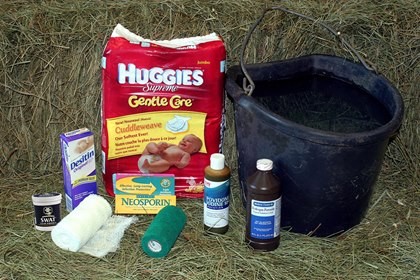
Every horse owner should have an equine first-aid kit in their barn and trailer. There are a variety of equine first-aid kits commercially available, ranging from less than $50 to more than $500. While the expensive kits offer a great deal of diverse treatment options, most horse owners can get by with a more affordable homemade kit for travel.

The Bucket The first step in making your own portable first-aid kit is locating a suitable bucket. A 5 gallon bucket with a snap on lid is the best option. If you don’t have a good bucket (with a lid) you may be able to get one from any of several community locations. Many delis, bakeries, and other food producing companies buy supplies (like pickles, frosting, and filling) by the bucket. When the contents of those buckets are used the facility is left with disposal. When you ask for a bucket you may want to specify the size (5 gallons) and that it have a lid. Smaller buckets may also be available and they can be useful for other things. If you cannot find a free bucket you should be able to buy one from a local feed, supply, or tack store.

The bucket serves two purposes: 1. It is a container to hold your first-aid kit items together and keep them clean; 2. It can be emptied and used as a bucket for first-aid purposes like washing wounds. Before you begin assembling your first-aid kit, thoroughly clean and dry your bucket. There should be no residue, lingering scent, or moisture in the bucket.

Filling the Bucket Supplies for your portable first-aid kit should be carefully selected to fit inside the bucket. Liquid and gel topical medications can be transferred from larger containers into smaller leak proof applicators. Leave the larger containers at home where you have more storage room. Travel shampoo containers work well for both liquids and gels. Small size Tupperware or Rubbermaid type food containers are also handy for holding more solid compounds, and organizing supplies.

Dry Supplies You’ll Need:

  • 16″ Combine Bandage
  • 4 – 3×4″ Non-stick Telfa Pads
  • Vetwrap
  • 5 – Wooden Tongue Depressors *
  • 4 – 10 cc. Syringes **
  • 4×4″ Gauze
  • Epsom Salt
  • Thermometer
  • Stethoscope
  • Scissors
  • Tweezers/Forceps
  • Duct Tape
  • 4 – Disposable Diapers ***
  • Gloves
  • Clean, Small Towel(s)
  • Hand Sanitizer
  • 2- 6″ Sections of Rubber Tubing ****
  • Small Flashlight

Wet Supplies You’ll Need:

  • Alcohol Preps OR 4×4″ Gauze in a container with ample Rubbing Alcohol
  • Betadine
  • Dawn Dish Soap OR Betadine Scrub OR Chlorhexidine Scrub
  • Triple Antibiotic Ointment
  • 1 Gallon Bottled Water
  • Antiseptic Wound Spray

You should talk to your veterinarian about other prescription medications to include in your portable first-aid kit like anti-inflammatories, analgesics, and tranquilizers. Some prescription medication may require special handling and storage and might have to housed in a location other than your handy first-aid bucket. Once the bucket is filled just snap on the lid and you are ready. As you deplete supplies from the kit simply replace them from your barn supply. It is important that you not only carry these items, but also know how to use them. To learn more about providing first-aid care for your horse, talk to your veterinarian or attend a training conducted by a veterinarian.

*Tongue depressors can be used to apply topical medication without contaminating the wound or the medication.

**You probably noticed that this list includes syringes but not needles. For a basic first-aid kit, without any injectable medication, you don’t need needles. The syringes can be used to flush wounds. A 10 cc syringe is especially nice as you can draw up 2 cc of Betadine and then fill the remainder of the syringe with water for safe flushing of punctures and other open wounds.

***Diapers work great for packing hooves and they are very absorbent and can also be used to staunch the blood flow from a seeping wound.

****Rubber tubing can be inserted into the horse’s nostril and secured, to keep the horse’s airway open in the event of snakebite, excessive bee stings, or other bites that cause severe swelling of the face.
 

Is Your Horse Happy in his Stall?

By Christa Lesté-Lasserre, MA and Diane Weinmann

Christa Lesté-Lasserre is a freelance writer based in France

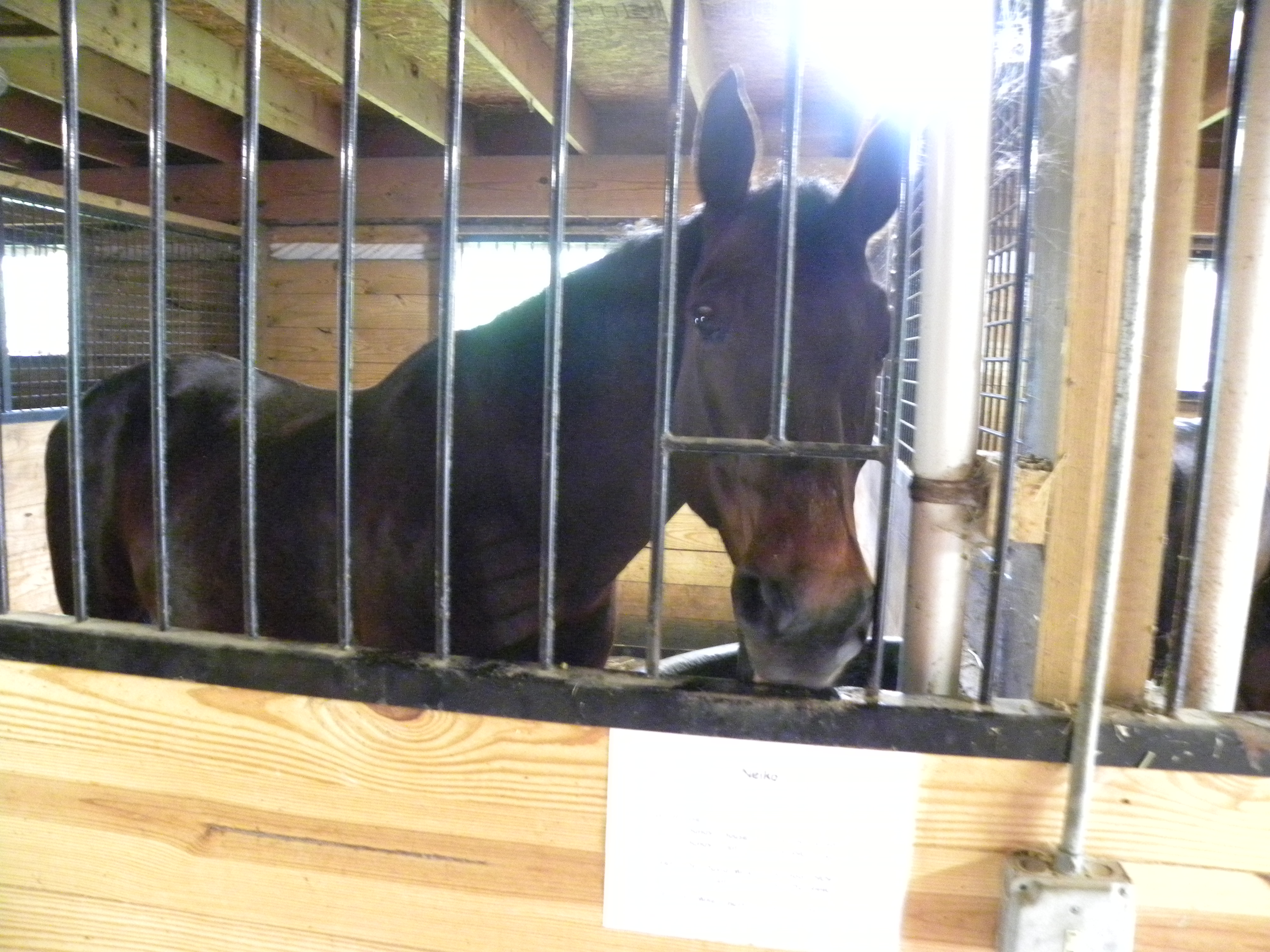
Neiko -passed away recently and was first horse I was able to "rescue" and find a new home
Neiko -passed away recently and was first horse I was able to “rescue” and find a new home

Is your horse happy in the stable? Well, I can tell you from experience that most of the time he is happy if everyone else is in their stalls. If he is alone in the barn and waiting for me to come out- let’s just say he is VERY happy to see me when I show up. On the other hand—on days, especially when we have had quite a few in a row, that he was unable to go outside (they usually get turned out daily weather permitting) he shows his displeasure by pooping in either his water bucket or food tray. Crazy, right? I mean he has to eat or drink out of it there so what is the deal? He is showing his extreme displeasure in the only way that makes sense to him by technically saying this NOT going out is CRAP!!! I laugh for a minute then groan when I am stuck cleaning it out. Sometimes I am lucky enough to be just told about by the unhappy person that found it first and cleaned it up like the angel they are!

But seriously….is your horse happy in the stable is a very important question and one that can polarize equestrians. But it’s also one that a French ethology expert tried to answer during her presentation at the 2015 French Equine Ethology Day, held in April in Saumur.

First, we can’t just look at the horse’s stall—a “box” in more than one sense of the term—but must consider the entire stable situation, said independent ethologist Hélène Roche, MSc. “We really need to see things from the horse’s point of view, not our own,” she said.

A horse expresses his happiness in the stable through emotions and behaviors, though we only see the behaviors, Roche said. Signs that a horse might be unhappy in his lodging include a depressed attitude (minimal reaction to sights and sounds, neck held slightly below the horizontal) and the development of stereotypies—cribbing, wind-sucking, weaving, excessive licking, etc. (Pooping in abnormal places!!)

While these visible behaviors might seem easy to read, others could be confusing or even mean the opposite of what we might think. Take, for example, the group of horses standing at the paddock gate as though they can’t wait to get back in the barn. Does that really indicate that the horse loves his stall? Roche said it could actually mean your horse’s paddock isn’t interesting enough for his basic needs.

“For the paddock to be a pleasant place for him, you can’t just have a few square yards of open space,” she said. “You need the fundamentals: something to eat, some other horses, a dry spot for rolling in, a place to get away from insects, etc. Without that, he probably does want to return to his stall!”

And even if your horse seems to “have fun” playing with balls and stall toys, that doesn’t necessarily mean he’s happy, Roche said. “You see these horses having a great time with those big balls on YouTube,” she said. “And it could be that they really are having genuine fun. But it’s also possible that they’re finding a substitute for social contact, and this is the way they express being deprived of social contact, which is especially true for males.”

Probably the only stable gadget that a horse can find truly pleasant and useful in accordance with his natural behavior is a big brush, said Roche. Having a solid surface for rubbing and scratching against could make for a happier stabled horse. I have not been able to find something like this for my horse’s stall so inventors get going!

Researchers are working to develop and evaluate better stabling systems that are in line with our modern understanding of equine welfare, while still respecting human convenience and time constraints, she said. In the meantime, keep an eye on your horse’s behavior—considering his world from his point of view—and adjust his environment as needed to improve his happiness and pray he doesn’t poop in his water bucket…ewwwww!


Sugars and Peppermints: Not Safe Treats for All Horses

By Clair Thunes, PhD, The Horse newsletter with comments by Diane Weinmann

peppermint-candy-istock

Ok, I admit it—my horse loves peppermints! In fact, he has that cute little ball that you put unwrapped mints into and he can nose it all around in his stall to keep him occupied when the weather requires him to be stall bound. So I saw this article by Clair and I thought I better read it and share it with other horse lovers who indulge their equine pets!

Simple sugars, such as the sucrose found in peppermints and sugar cubes, are absorbed by the horse’s small intestine as glucose and fructose. Glucose causes release of insulin to facilitate the entry of glucose in to cells. Fructose (not to be confused with fructans) is metabolized differently. Only metabolized in the liver, fructose is more lipogenic than glucose, meaning that it’s more likely to lead to production of fat.

Most concern about sugar and starch intake has stemmed from our increasing knowledge about insulin resistance (IR), laminitis, polysaccharide storage myopathies (PSSM), and equine gastric ulcer syndrome (EGUS). Horses with IR release more insulin than is normal in order to remove glucose from their blood stream. As a result, while circulating glucose tends to be normal, circulating insulin is elevated. High circulating insulin creates an increased risk for developing laminitis. Horses with PSSM store glycogen (the storage form of glucose) abnormally in their muscle tissue, and diets high in starch and sugar cause increased production of volatile fatty acids in the gastric stomach causing a more acidic environment and a greater likelihood of a horse developing EGUS

I think it’s important to put the questions of sugar in treats in perspective of a horse’s typical daily non-structural carbohydrate consumption. If we assume a 1,200-pound horse eating 2% of body weight as dry matter from hay a day, and that the hay contains 10% moisture and 10 % nonstructural carbohydrate (NSC) on a dry-matter basis (a value often used as the recommended upper NSC level for horses with metabolic issues, such as IR and PSSM), this horse is consuming 1,090 grams of NSC (starch and simple sugars) per day.

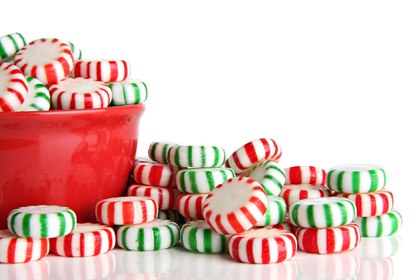
A pure sugar cube weighing about 4 grams is 100% sucrose. The popular round, red-and-white peppermint candies have a human serving size of three pieces (about 15 grams) and of that between 8 and 10 grams are sugar. Traditional peppermint candy canes are heavier at 18 grams and provide about 12 to 14 grams of sugar. You can see that in the context of the above horse’s daily diet these are tiny intakes of sugar. However, there are some important considerations.

When feeding a horse hay, you’re also feeding it proteins and minerals that help buffer stomach acid. Additionally, hay’s fiber component impacts the rate at which the NSC reaches the small intestine and is absorbed. The sugar in sugar cubes dissolves quickly and will move with the liquid fraction of the digesta, which moves more rapidly than larger fibrous particles. This means that that the sugar will likely be absorbed relatively soon after it is fed. This makes it potentially more likely to cause a spike in blood glucose than the NSC contained within hay.

Feeding a healthy horse three or four sugar cubes is unlikely to cause a significant glucose spike; however, for a horse with uncontrolled IR, PSSM, or a laminitis history, feeding sugar cubes isn’t a risk worth taking. Skip the sugary treats, too, if your horse is overweight, especially if he has a cresty neck. After all, every calorie counts and calories from treats mean feeding fewer calories from “real” food. Human research shows that tissues in insulin resistant people are more sensitive to insulin after exercise. This may or may not be the case in horses, but if it is, then your horse might be better able to handle the sugar in these treats when they are given shortly after work.

For the otherwise healthy horse, consuming a candy cane or a few peppermint candies is unlikely to have any major impact. Bottom line for me—my horse has never had any laminitis history and is healthy so he will continue to be entertained by his treat ball but I will ensure I only put less than 5 peppermints in the ball at a time (he doesn’t get it every day –it’s weather induced). He sure loves to hear those mints rattle around in there!