By Dr. Becker and Diane Weinmann
At some point in their lives, many kitties do something their humans find quite repulsive – they pee outside the litterbox. (Some cats also poop outside the box, but this is a much less common problem.) Even worse, for reasons known only to them, some kitties turn their owner’s bed into a second bathroom.
And let’s face it – there are few things as unnerving as waking up in a puddle of piddle left by your loving kitty.
But all joking aside, feline house soiling is such a widespread problem that it is the number one reason cats are banished to the outdoors, dropped off at animal shelters, or even euthanized. Additionally, this is the number one reason why clients call Diane, an animal communicator, to determine the root of the problem as many times it is emotionally based. That’s why it’s important to address a litterbox issue as soon as it occurs.
If Kitty is Relieving Herself Outside the Litterbox, There’s a Reason
Cats adapt quickly to using a litterbox because their natural instinct is to eliminate in a substrate (earthy material) that allows them to bury their urine and feces.
Domesticated cats descended from African wildcats for which the desert served as a giant cat box. Modern-day felines are probably attracted to litter because it’s the closest substrate to sand they can find inside a house.
It’s also the nature of cats to bury their feces in their urine, and wet desert sand is the perfect substrate. This is likely why most domesticated kitties prefer clumping litter to other varieties. Although, I have had cats tell me, as an animal communicator, that they do not like the pebbles in their toes especially as they get older and are less able to groom themselves correctly.
Since it’s entirely natural for your cat to seek out her litterbox to eliminate in, you should immediately assume something is haywire if she chooses another location to relieve herself.
It’s is not entirely misguided to suspect your feline companion has suddenly developed anger issues or an attitude problem—because I have found through my animal communication business that sometimes this is indeed what is going on. But—I always recommend that vet care be sought out to determine if any physical reasons exist for your cat’s behavior before assuming they are mad that you moved the furniture or got another pet.
First Stop: Your Veterinarian’s Office
Any behavior change in a cat is the first sign (and often the only sign) of a medical condition, so if your kitty has started relieving himself in inappropriate places, you’ll want to rule out a health problem first.
Urinating outside the litterbox is one of the primary symptoms of feline lower urinary tract disease (FLUTD), which is a very common condition in cats. Other signs your pet might have this problem include:
- Frequent or prolonged attempts to urinate
- Straining to urinate
- Crying out while urinating
- Blood in the urine
- Excessive licking of the genital area
Any kitty can develop a lower urinary tract disorder, but it’s most commonly seen in cats who are middle-aged, use an indoor litterbox exclusively, eat a kibble only diet, don’t get enough exercise and are overweight, and who are stressed by their environment.
If you suspect your cat might have a lower urinary tract infection, it’s important to make an appointment with your veterinarian.
If your cat isn’t passing urine, a situation more commonly seen in males than females but can happen to either sex, this is a life-threatening medical emergency and you should seek immediate care.
Once a kitty’s urethra is blocked, the kidneys can no longer do their job. This can lead to uremia, a ruptured bladder, as well as organ failure and death within just a day or two.
Besides lower urinary tract disorders, other medical conditions that can contribute to inappropriate elimination include diabetes, cognitive dysfunction, and hyperthyroidism.
Is the Problem Actually Urine Marking?
Another common reason cats pee outside the litterbox is to urine mark. Kitties who urine mark generally use the litterbox normally, but also perform marking behaviors. Some cats do both house soiling and urine marking.
It’s easy to tell the difference between the two once you know what to look for. Urine marking, when it takes the form of spraying, happens on vertical surfaces.
Urine marking can be hormonally driven, but more often it’s the result of a natural system of feline communication, or stress. Examples of common kitty stressors include:
- The addition or loss of a pet or human family member
- Changes in the daily routine brought on by a change in work hours, illness, etc.
- A neighbor’s cat or a stray in your yard or around the outside of your home
- Illness of another cat in the home, or a change in the relationship between cats
- Aggression between cats
Both male and female cats spray, as do both neutered and intact cats. However, neutered cats spray less, and neutering can reduce or eliminate spraying in some cases.
But some cats urine mark on horizontal surfaces, which can make it more difficult to determine whether you have a marking problem or a house soiling problem.
Where your cat marks can provide clues, for example:
- If he marks under windows or on baseboards, he may perceive a threat from animals outside – usually other cats
- If he marks on or near furniture or doors inside your home, he might be having problems with other cats in the household
- If your cat marks personal belongings – clothes, bed linens, a favorite chair or a computer keyboard – he may have some anxiety about the human who owns those things
Tackling Urine Marking
Resolving urine marking involves identifying and addressing the source of your cat’s stress. When did the marking begin, and what was happening in her environment at that time? Just as cats favor certain scratching surfaces, they also return to the same spot to urine mark. Diane’s cat was traumatized when he ran into the basement that was all ripped up due to a water problem (basement was excavated). He took one look at what he considered his safe haven and started spraying on my custom made drapes in my living room. He was a fixed male and this issue did not resolve until we moved!
You’ll need to use an enzyme-based product for clean ups to remove stains and odor.
You might also want to spray a synthetic pheromone called Feliway on kitty’s favorite marking spots. Cats also “mark” by rubbing their cheeks against objects (they do it to you when they rub against you), and Feliway may encourage your cat to mark with his cheeks instead of his urine. Cases of urine marking can be quite difficult to manage, as often the root cause, if determined, can’t be resolved completely. And sometimes despite addressing all possibilities, cats still mark. As I mentioned above, when we moved the situation solved itself.
Litterbox Aversion
A third very common reason for inappropriate elimination in cats is distaste for the litterbox. Kitties who are comfortable with their bathroom arrangement typically approach and jump or climb into the box without hesitation; take a little time to poke around and choose a good spot; dig a hole; turn around and do their business; inspect the result and then cover it up with litter.
Cats who are unhappy with their litterbox may approach it tentatively. They may balance on the side of the box or put only two feet in. They may actually use the litter, but immediately leap from the box when finished. Worst case they may walk to the box, sniff it, turn, walk away … and jump up on your bed to urinate. I have seen this quite a lot in my animal communication business.
Pooping outside the box, but very close to the box, is almost always a litterbox aversion problem. Kitties develop litterbox loathing for a number of reasons. Perhaps your cat’s box isn’t being cleaned frequently, or frequently enough to meet her standards.
Maybe she’s sensitive to a chemical used to clean the box, or perhaps she’s not fond of a box with a hood. The box may be in a noisy or high traffic location, or where another pet in the household can trap kitty in there. Aroma is a deciding factor for many cats. Whether they can smell of the litter itself or another cat in the household has used a specific cat’s perceived box –either way, they chose to not use one particular box anymore.
How to Cure Litterbox Aversion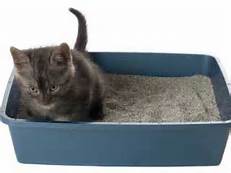
If you have multiple cats, you may need to add more boxes. The general guideline is one box per cat, and one extra. If your house has more than one floor, you should have at least one box per floor. This has worked in most situations and I find when you put each box on a different floor or location it helps the individual cat know which one they can use.
It could be kitty doesn’t like the type of litter in the box, or it’s not deep enough (four inches is recommended). You can discover your pet’s litter preference by buying the smallest amount available of several kinds of litter (unscented, different particle sizes, and made from different materials), and several inexpensive litterboxes. In my business, I’ve had cats tell me that they didn’t like the pebbles in their toes!
Place the boxes with different litters side by side and see which box gets used most often. This works very well and allowing the cat to pick their choices. Once you’ve discovered your cat’s litter preference, you can donate the remaining litter and extra boxes to your local shelter or cat rescue organization.
Find locations for litterboxes that are somewhat out of the way, and away from noisy household machinery and appliances. Choose warm locations in the house rather than the basement or garage. And make sure boxes aren’t close to kitty’s food or water bowls.
Boxes should be kept scrupulously clean. They should be scooped at least once a day and more often if you’re dealing with a potential litterbox aversion situation. Dump all the used litter every two to four weeks (I recommend every two weeks, minimum), sanitize the box with soap and warm water, dry thoroughly and add fresh litter. Watch the cleaning products you use—vinegar and water is probably best to eliminate the likelihood of your kitty to be repulsed by the lingering smell of the cleaner. Just remember –cat’s noses are very sensitive! Plastic litterboxes should be replaced every year or two.
I hope all these ideas serve to keep you and your kitties happy and eliminating in the appropriate place but if not, please call me or another animal communicator to get down to the fundamentals of what is bothering your beloved cat!

 Diane Weinmann's HOPE