Dog With These 2 Undesirable Behaviors?

By Dr. Becker and comments by Diane Weinmann

faith-on-couch

I think one of the most difficult concepts for dog parents to grasp when it comes to training their canine companion is that punishment is typically ineffective, and it’s often counterproductive. In other words, you can make your dog’s behavior worse using punitive tactics. As veterinary behaviorist Dr. Valarie Tynes explains:

“When punishment is used incorrectly, it will appear unpredictable and confusing, so many pets become anxious or fearful around the owner that administers the punishment.

When punishment is used in an attempt to train an animal that is already afraid or anxious, [the] fear and anxiety are likely to worsen and may lead to aggression“.1

According to Tynes, three important rules must be met for punishment (correction) to be effective:

1. The punishment must occur every time the unwanted behavior occurs

2. The punishment must be administered within a second or two of the inappropriate behavior

3. The punishment must be aversive enough to stop the dog from repeating the unwanted behavior in the future but not be so aversive as to frighten the dog

Unless your dog is physically tethered to you (e.g., you have him on a leash and the leash is attached to you in some manner), it will be extremely difficult to be on top of him when he misbehaves, and within a second or two of his mischief.

In addition, in my experience it’s the rare individual who can deliver “just enough” punishment to train a dog not to repeat the behavior without frightening him, or conversely, without teaching him to simply ignore verbal commands.

In other words, it’s easy to over-deliver or under-deliver punishment. If you allow anger into the equation, it can result in both physical and emotional harm to your dog. The flip side of the coin is punishment that’s so wishy-washy and non-committal the dog learns to simply ignore you. As Tynes points out:

“Meeting all three of these criteria can be difficult. That’s why punishment often fails to solve behavior problems and should not be the first training method of choice. Positive reinforcement training, in which animals are rewarded for appropriate behaviors, is safer and more effective.”

I absolutely agree with this, and can’t stress strongly enough the importance of positive reinforcement behavior training, not only to help your dog become a good canine citizen, but also to preserve and protect the close and priceless bond you share with him. 


Diane’s theory is catch them doing something good and reward them for that!  I love this method and it really makes you pay attention to your pet and how many times they are displaying good behavior vs bad.  So make time each day to catch them doing something good then praise and reward them for it showing them in your mind what they are doing that is so wonderful!  This could be as simple as being good while you eat dinner, laying down next to the cat without tormenting him, not jumping on someone, or coming when called.

Why Punishment Fails, Example No. 1: Couch-Loving Dog

Tynes offers two examples of why punishment usually doesn’t work. In the first, a dog who isn’t allowed on the couch is routinely found there by her owner, who reacts by yelling and waving a rolled-up newspaper at the dog each time the behavior occurs.

The dog’s response is to get off the couch when she’s yelled at, only to return when her owner isn’t around. As Tynes points out, because the dog still gets on the couch when the owner is away, she’s being rewarded some of the time for her undesirable behavior.

Remember rule No. 1 above? “The punishment must occur every time the unwanted behavior occurs.” In this case, it’s not possible for the couch-surfing canine’s owner to be there to deliver punishment each and every time the behavior occurs, so the punishment doesn’t solve the problem long-term.

I’d venture to guess the vast majority of dog parents are in a similar predicament. Most people lead busy lives, and it’s simply not possible to keep an eye on the dog 24 hours a day, seven days a week, 365 days a year.

In addition, punitive tactics delivered repeatedly have a way of escalating, because the dog parent grows increasingly frustrated that the punishment isn’t working. If the severity of the punishment increases, the dog may grow fearful of her owner, or a feistier dog may respond with growling or snapping.

Why Punishment Fails, Example No. 2: Jumping Dog

In Tynes’ second example, a dog greets people by jumping on them, and the owners’ response is to either knee the dog in the chest or kick him when he does it to them. As a result, the dog now avoids the husband because the kicking has caused him to be fearful. However, he still jumps on everyone else. As Tynes explains:

“Many dogs are highly motivated to greet people by getting close to their faces. In most cases, kneeing or kicking such a dog is less powerful than the dog’s desire to greet people by jumping on them.”

I think this is good information that can further your understanding of your dog’s motivation if he’s also a “jump greeter.” You know how some people greet everyone they meet with a big hug and a kiss? Seems there are dogs who are similarly inspired!

Back to the dog in the example — since not everyone he meets responds to his jumping with a knee or a kick (thank goodness), the punishment doesn’t meet rule No. 2 above: “The punishment must be administered within a second or two of the inappropriate behavior.”

It also doesn’t meet rule No. 3: “The punishment must be aversive enough to stop the dog from repeating the unwanted behavior in the future but not be so aversive as to frighten the dog.”

According to Tynes, this dog doesn’t always perceive kneeing as punishment, but rather often views it as reinforcement for his behavior because he’s getting attention (negative though it may be).

A Better Approach to Reclaiming the Couch

In the first example of the couch-loving dog, Tynes suggests blocking the dog’s access to the furniture whenever she’s home and unsupervised. A couple of options are crate training or confining her to another room in the house.

However, physically separating the dog from her beloved couch won’t teach her to stay off it, so I would suggest the crate or the separate room only while her owner is helping her learn what to do instead of getting up on the furniture.

Positive reinforcement behavior training is about showing your dog what you want her to do instead of the behavior you don’t want her to do. In this instance, the owner will need both a deterrent and an alternative behavior to teach.

An effective deterrent makes it uncomfortable for the dog to lie on the couch. Examples: a plastic cover over the couch (most dogs don’t like plastic), or one of those rubber carpet runners with the spikey side up.

Teaching the alternative behavior involves placing a comfy dog bed close to the couch, encouraging her with treats to lie down in it, and rewarding her each time she does. Once the dog learns to associate discomfort with the couch, and a yummy treat with lying in her own bed, the couch-surfing behavior should be gradually extinguished.

A Better Approach to Extinguishing Jumping Behavior

Kneeing a jumping dog or worse, kicking him as a form of punishment (or simply to keep him off you) is another example in which the dog isn’t learning a more acceptable behavior to replace the unacceptable one. In addition, you can cause injury to the dog and/or yourself using your knee or foot against him.

And there’s also the issue of unintentionally reinforcing the bad behavior because you’re paying attention to him when he jumps. This dog needs a replacement behavior that is equally motivating. Tynes suggests teaching him to sit to greet everyone. Sitting becomes the alternative behavior that gets rewarded with petting and/or a food treat.

While he’s being taught to sit to greet people, it’s important to stop reacting when he jumps on you. Turn your back, stand straight and ignore him. This is the opposite of what he wants (attention) and sends the message that you don’t welcome his exuberant jumping routine.

Positive Reinforcement Dog Training in 5 Simple Steps

The goal of positive reinforcement behavior training is to use very small-sized treats (pea-sized is good, and you can even use frozen peas if your dog seems to like them) and verbal praise and affection to encourage desired behaviors in your dog.

1. Come up with short, preferably one-word commands for the behaviors you want to teach your pet. Examples are Come, Sit, Stay, Down, Heel, Off, etc. Make sure all members of your family consistently use exactly the same command for each behavior.

2. As soon as your dog performs the desired behavior, reward him immediately with a treat and verbal praise. Do this every time he responds appropriately to a command. You want him to connect the behavior he performed with the treat. This of course means you’ll need to have treats on you whenever you give your dog commands in the beginning.

3. Keep training sessions short and fun. You want your dog to associate good things with obeying your commands. You also want to use training time as an opportunity to deepen your bond with your pet.

4. Gradually back off the treats and use them only intermittently once your dog has learned a new behavior. Eventually they’ll no longer be necessary, but you should always reward your dog with verbal praise whenever he obeys a command.

5. Continue to use positive reinforcement to maintain the behaviors you desire. Reward-based training helps create a range of desirable behaviors in your pet, which builds mutual feelings of trust and confidence.

If your dog is displaying undesirable behavior and you’re not sure you can deal with it on your own, talk with your veterinarian, a positive dog trainer or a veterinary behaviorist.  Additionally you can call me, Diane Weinmann, an animal communicator, to talk with your pet about the expectations of their behavior.

 Dog and Hand

How to Pick up your Dog

By Dr. Beckerpick-up-dog

There are times in every dog parent’s life, even owners of large and giant breeds, when it becomes necessary to physically lift their canine companion in their arms.

It could be a very ordinary occasion like a trip in the car, or it might be an extraordinary circumstance in which you have to pick up your pet to prevent a fight or traumatic injury of some kind.

Picking up a small- or even medium-sized dog wouldn’t seem to present a big challenge, but you’d be surprised how many well-meaning people get it mostly wrong. And lifting a large or heavy dog is an even bigger project, especially if you’re not very large or strong yourself.

Before I explain how to pick up your dog the right way, though, let’s get the “don’ts” out of the way.

3 Don’ts When Picking Up Your Dog

1. Don’t involve your dog’s legs.

Your dog’s front and back limbs aren’t intended as suspension devices, nor can they be expected to support the full weight of his body if, heaven forbid, he’s lifted by them.

Children who don’t know better tend to lift by the front legs, whereas adults are more apt to put their hands under the armpits and lift as they would a child. Picking up a dog in this manner strains the muscles in the front legs and spine, which can result in torn ligaments and even a dislocated shoulder or elbow.

There’s also the risk of dropping the dog, and in older dogs with arthritis or degenerative joint disease, this type of lifting can be extremely painful.

2. Don’t “scruff” your dog.

Yes, mother dogs carry their pups by the scruff of the neck in their first few weeks of life. However, this happens only for a very brief period and doesn’t continue as the puppies get larger.

“Scruffing” is an unnatural, uncomfortable and even painful way for larger puppies and certainly adult dogs to be lifted or carried.

3. Don’t hold his collar or tail when picking your dog up.

It should go without saying that pulling on a dog’s collar, especially while lifting him, can cut off his air supply and cause him to choke. It’s also a good way to do serious permanent damage to the very delicate organs located in his neck, including the throat, larynx and trachea.

Just as your dog’s collar should never serve as a “handle” to lift him, neither should his tail. Damage caused by pulling your dog’s tail can affect the nerves and muscles that move the tail as well as those that control elimination.

Significant injury can cause the tail to hang limply, no longer move or even affect your dog’s ability to urinate or defecate on his own.

If you regularly pick up your dog incorrectly but she never complains, it doesn’t mean she’s okay with it or that she, for some reason, can be picked differently from other dogs. Many pets will endure a great deal of discomfort and even pain without yelping or crying.

Chances are your dog is sending you a signal, but you don’t recognize it as a sign of distress, for example, yawning, lip licking, looking away or struggling to get free. These are all signs of a dog who is at a minimum feeling anxious, and may even be in pain.

How to Lift a Small- or Medium-Size Dog the Right Way

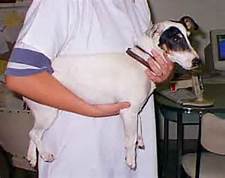
If your dog is less than 25 pounds, slide your dominant arm under his chest between his front legs, and tuck his back end between your arm and body as you lift him.

If your dog is in the 25- to 40-pound range, put your dominant arm behind his back legs, your other arm around his chest in front of the back legs and hold him against your chest as you lift.

This method will help him feel secure and comfortable as you pick him up, and will also insure you don’t accidently drop him.

For low-to-the-ground dogs and really tiny fellows, I recommend teaching a verbal “lift-off” cue. Small dogs are often startled to be suddenly lifted off the ground by a human.

If you put yourself in his place, imagining at any moment you will lose the ground beneath your feet, you can see why it could be a stressful event. That’s why it’s good to train your dog with a verbal cue that signals you’re about to pick him up. Just make it a simple one-word signal.

To train your pet to the cue, put your hands on him, say the word and apply just a bit of pressure without actually lifting him. This gives him time to understand he’s about to be lifted.

When you know he’s aware you’re about to pick him up, go ahead and do so. Consistent use of the cue will help him learn to prepare for “lift off.”

How to Lift a Large Dog

The best way to lift a large dog is with two people, so depending on your size and health, I recommend getting help if your pet is over 40 pounds.

One of you should lift from under your dog’s chest while the other lifts the abdomen and back end. Dogs tend to struggle more and risk being dropped when they aren’t properly supported while being picked up.

Lifting a Pregnant or Injured Dog

If your dog is expecting, you should avoid the belly area if you need to pick her up. Put your hands under her chest and back end instead. If your dog has an injured or sore back, get help if necessary so that you can keep her back completely level as she’s lifted.

One of my favorite techniques is the “dog taco wrap.” While your dog is lying on her dog bed, you simply fold the edges up and pick her up in the bed. You can also use a beach towel for this purpose with smaller dogs. It’s best to pick up your dog when he’s relaxed, because it’s much easier to lose your grip on a bouncy or wiggly dog. If your dog won’t sit still and absolutely must be picked up, as a last resort, you can use a comforter or blanket to scoop him into your arms.

For dogs who are frightened or in pain, it’s important to avoid the mouth area to prevent a bite. You might want to consider a homemade muzzle (as long as she’s breathing normal), as well as sliding her onto a board for support.

https://youtu.be/EkX0MdrxM6g


Love These Chews, but They Fracture Teeth Like Dogs Crazy

By Dr. Becker and comments by Diane Weinmanndog-with-bone-2

When it comes to recreational bones and chews for dogs, antlers seem to be a blessing for some dogs, and a curse for others. The upside to antlers is that most dogs seem to love them, they’re long-lasting and they help keep teeth clean.

However, an increasing number of veterinarians are discouraging dog guardians from offering very hard chews, including antlers, due to the potential for broken teeth. In the U.K., veterinarians have seen a steady increase in fractured carnassial teeth. And while broken teeth are common in dogs, fractures in back teeth are not.


The veterinary dentist Dr. Becker works with is fond of saying he has been able to fund an entire wing of his dental clinic thanks to dog owners offering antler bones to aggressive chewers!

Anything your dog chews on that is harder than his teeth can cause a fracture, largely due to the force with which dogs are able to bite down. This typically occurs when a dog moves the chew or bone toward the back of his mouth on one side and chomps down on it like this fellow here:

According to the U.K. DentalVets group, “The teeth damaged have all had the same buccal slab fractures of the upper carnassials (see image). Many have fractured so severely that surgical extraction is the only treatment possible.”1

What Happens When Your Dog Cracks a Tooth

When your dog breaks a tooth, the pulp — which is the sensitive nerve inside — can be exposed. Not only is an exposed nerve extremely painful, it can also lead to a deep infection and root abscess.

Most pets with tooth fractures don’t show obvious signs of pain, but sadly, many suffer silently for weeks, months or even years before the situation progresses to the point where they can’t eat comfortably and lose their appetite. The longer a broken tooth goes untreated, the worse it gets.

Oral bacteria can invade and infect the tooth pulp and cause it to die. Next, the infection often moves from the root tip to the bone, destroying it. In severe cases, the infection moves past the bone into the skin, forming a facial fistula (a whole in the face through which the infection drains).

Fortunately, not all broken teeth are so serious. If only the enamel has been fractured, the tooth can often be smoothed to remove sharp edges.

However, if x-rays indicate the tooth is dead, if pulp is visible or if the tooth has turned from white to pink, purple, grey or black, treatment typically involves either extraction or root canal therapy.

It’s important for every dog parent to understand that a fractured tooth requires prompt veterinary care.

Antlers and Other Hard Chews Result in Lots of Fractured Teeth

I spend a lot of time with dog parents going over detailed recommendations for appropriate recreational bones.

Some of my clients think I’m overplaying the importance of choosing the right type of bone for their dog, but part of the reason I’m so detailed and thorough is to avoid fractures and other chew bone-related catastrophes.

There are some dogs for which no bone or chew is appropriate because they are just too aggressive, or they’ve already broken too many teeth. The veterinary dentist I work with, Dr. Stephen Juriga, sees hundreds of cases of fractured teeth as a result of inappropriate raw bones, and not just from my practice.

He notes that antlers are often a problem, as are Nylabones. Anything you can’t put a dent in with your fingernail has the potential to fracture the crown of your dog’s tooth.

It’s very important to pair the personality, breed, age and tooth condition of the dog with the right type of chew. One size does not fit all when it comes to recreational chews and bones.

The Type of Chew I Recommend for Forceful Chewerschewing-bone

The first thing to ask yourself: “Is my dog an aggressive chewer?” This type of chewer is more interested in eating the bone than leisurely gnawing on it. She wants to consume the chew in its entirety, and the sooner, the better.

Many aggressive chewers fracture their teeth. They acquire multiple slab fractures in their eagerness to break the bone down as quickly as possible. These dogs get hold of a bone and chew like mad, fracturing or wearing down their teeth very quickly.

If this describes your dog, needless to say, she shouldn’t be given hard bones like antlers or marrowbones smaller than the size of her head. I also advise against thin or narrow bones that fit nicely into her mouth, allowing her to apply a strong vertical bite force.

My pack includes pit bulls who are very powerful chewers. They’re not into swallowing their bones, but they’re very passionate chewers. Offering them small, narrow femur rings or antlers would be a really bad idea, because the vertical bite force as they chomped down on an antler could easily break teeth.

What I offer my pitties are big, raw knucklebones. Raw knucklebones are much softer than rock hard antlers and are gentler on the teeth. I also monitor their chewing very closely, because they can whittle a large bone down to the size of a ping-pong ball in about an hour.

Once a bone is that small, it’s too small to be safe, so I watch my dogs closely and when they’ve worked a bone down significantly, I take it away.

Are Antlers Appropriate for Any Dog?

If your dog happens to be a soft chewer who just enjoys holding or gently gnawing on a bone, antlers may be a good choice. You can purchase elk, moose or deer antlers, and they’re very economical because they last forever.

Antlers come in a variety of sizes and can be split, cut or whole, but again, you don’t want to give a small antler to a large dog because of the potential for tooth fracture. Giving small antlers to small dogs and big antlers to big dogs is fine, but first you want to make sure they’re gentle chewers.

An alternative for any chewer is sweet potato chews or liver chews.  They are nutritious for your dog and will not hurt their teeth no matter how hard they chew.  Contact Diane Weinmann to find out where to purchase them.  See www.theloveofanimals.com


Scoop the Poop

By Dr. Becker and comments by Diane Weinmanndog on toliet

If you have a dog, picking up dog poop becomes just another part of life. After you’ve scooped up the poop and tossed it in the trash, you may not give it another thought, nor do most of the other owners of the 83 million pet dogs in the U.S.

Yet, perhaps we should give some thought to dog poop and, more importantly, how to best dispose of it. America’s pet dogs produce 10.6 million tons of poop each year.1 Add in enough plastic poop bags to contain it, and you’ve got a hefty load in the nation’s landfills.


In Cleveland, Ohio we spend a lot of time in the Metroparks with our dogs. The park system provides disposable bags to pick up your dog’s droppings which are biodegradable.

Dog Poop Leaves a Surprisingly Large Environmental Footprint

Dog poop creates a surprisingly high environmental burden. While it doesn’t compare to that created by industrial agriculture’s concentrated animal feeding operations (CAFOs), bacteria, viruses and parasites in dog waste can be a problem.

In some areas, dog waste can lead to high bacteria counts in rivers, streams and other waterways. It can even be “the difference between a beach closing and a beach not closing,” according to California Polytechnic State University microbiologist Christopher Kitts.2


Further, a study conducted by University of Colorado Boulder researchers revealed anywhere from 10 percent to more than 50 percent of bacteria in the air in wintertime may come from dog poop.3 OnEarth also reported:4“Studies have traced 20 to 30 percent of the bacteria in water samples from urban watersheds to dog waste.

Just two to three days of waste from 100 dogs can contribute enough bacteria, nitrogen, and phosphorous to close 20 miles of a bay watershed to swimming and shellfishing, according to the Environmental Protection Agency.”

 dog poop on beach

Forward-Thinking Dog Parks Turn Dog Waste Into Compost

There’s an alternative to tossing dog waste in the trash or, worse, leaving it on the ground in public places: compost.

It’s often said that dog waste can’t be composted because it carries potential pathogens, but when done correctly, dog waste can be composted safely and to great benefit of the surrounding environment.

A small number of dog parks have even caught on to the trend. At Brooklyn, New York’s East River State Park, for instance, two compost bins have been added for dog owners to dispose of their pet’s waste. The park even has a number of pooper-scoopers and brown paper bags for owners’ use.

After being mixed with sawdust and “cooked,” the poop will turn into useable compost that will be spread around city park gardens. “We figured we can use something people don’t want and turn it into something great,” Leslie Wright, New York City’s regional director of state parks, told the New York Post.5

Only two other state parks have similar dog waste composting programs, Robert H. Treman State Park in Ithaca, New York and Denali National Park in Alaska.

Considering one dog park that entertains 50 to 75 dogs daily may generate close to 1.5 tons of dog waste a year, such programs have the potential to make real positive change.6

Sled Dog Waste Composted at Alaska’s Denali National Park

The average dog excretes 274 pounds of waste a year, according to the Environmental Protection Agency (EPA). In Alaska, where sled dogs play an important cultural and practical role, dog waste can be a serious issue.

A musher with 20 sled dogs would need to dispose of more than 2 tons of dog waste each year.7


At Denali National Park kennels, which house a working sled dog team, up to 50 pounds of dog poop are produced daily. For years, the waste was simply flung down a hill behind the kennels, but in 1980 a composting program was established.

Now, the kennels serve as an important example of how to turn waste into an asset. According to the Denali National Park blog:8


“We built a four bin system in which the waste (nitrogen) is mixed with sawdust (carbon) and water and rotated regularly until it transforms into a soil that is jam-packed with nutrients.

The mixture of waste, sawdust, and water is carefully concocted to give us a carbon: nitrogen ratio of 20 or 30:1, with the consistency of a worn out sponge. Once the texture and ratio are adequate, we’ll start monitoring the temperature of the pile.

As the pile sits, microorganisms digest the nitrogen and carbon of the waste mixture and heat is produced. The temperature of the pile tells you the level of microbial activity within it. In Denali, we wait for a pile to heat up to 145 degrees before we turn it.

When the microorganisms have broken down all the organic material, the pile is done ‘cooking.’ This process can take anywhere from four to eight weeks. The odorless, nutrient-rich material that is produced is called humus.

It increases the nutrient content of soils and helps retain moisture. Composting also reduces the volume of waste by over 50 percent!”

How to Compost Your Own Dog’s Waste

If you already have a compost bin in your yard that you use for food scraps and yard waste, good for you! However, you’ll want to create a separate bin for composting dog waste.

To do this, you’ll need to add a carbon source such as sawdust. The University of Florida’s Institute of Food and Agricultural Services (UF/IFAS) Extension recommends a recipe of 2 parts dog manure to 1 part sawdust.9


Mix the two together well once a good-sized pile has been collected, then allow it to heat up to at least 140 degrees. You should turn the compost pile at least once a week. In about four to eight weeks, you should have dirt-like compost that you can add to your flower gardens.

An important caveat: researchers are not yet sure if composted dog waste gets hot enough to kill large roundworms (which are fairly heat-resistant).10


Because of this, you should only use the resulting compost on non-food gardens, such as flowerbeds and shrubs. UF/IFAS even has detailed plans for how to build your own self-contained, covered and turnable compost bin using a plastic or metal garbage can.

Diane is lucky because her dog Neko doesn’t really go in the grass but loves to go under trees, bushes and plants around the house so cutting the grass is not full of “land mines”!


Finally, if you don’t intend to compost your dog’s waste, you can also flush it, which is the disposal method recommended by the EPA. I never actually thought of flushing it which shows you how uncreative I am!

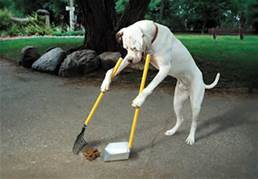
dog scooping poop


Seizures in Dogs

Seizures in Dogs german-shepherd-12270656

You dog is perfectly healthy one minute and the next he’s having a seizure. It may be small or it may be a long lasting one.  What do you do?

Your veterinarian can perform several tests to help ascertain the cause of seizures, including CBC, chemistry panel, liver function test, and advance imaging of the brain (i.e., CT or MRI scans). However, it is helpful if you note when the attack occurred, the duration of the seizure, and what the dog was doing prior to the incident.

As your dog is having a seizure, don’t put anything in his mouth. Dogs cannot choke on their tongues. If you can, time the seizure – it is important info for your vet.

If the seizure lasts for more than a couple of minutes, your dog is at risk of overheating. Turn a fan on your dog and put cold water on his paws to cool him down. The longer a seizure goes on, the higher a dog’s body temperature can rise, and he may have problems breathing. This can raise his risk of brain damage. Your vet may give your dog IV Valium to stop the seizure.

Talk to your dog softly and gently touch him to assure him if you feel it is safe to do so.

What Should I Expect When I Take My Dog to the Vet?

Your vet will want to do a thorough physical exam and get some lab work to look for the causes of your dog’s seizures.

Your vet may prescribe medicines to control seizures, like phenobarbital or potassium bromide. You can give your dog phenobarbital twice a day, but over time it can damage his liver. Dogs that take phenobarbital need blood tests about every 6 months.

Potassium bromide doesn’t work its way through the liver, making it a better choice for young dogs that need medicine for life.

Please note that the activity you observed is very important. In order to determine if seizures are due to an underlying disease or are a result of idiopathic inherited epilepsy, your veterinarian will consider the age and breed of your dog and the changes you observed, do various diagnostic tests to rule out other possible causes, and ask questions such as whether your dog may have been exposed to any toxins or possibly received a head injury.

My dog, Cocoa, went into numerous seizures because he ate rat poison that my husband put in a mole hole in the backyard—don’t ever do this! We had a happy outcome- $600 dollars later (and this was at least 15 years ago!) I like to spread the word since this episode that you NEVER, NEVER put chemicals or poisons in any area where your pet may wander especially in the house or back/front yard! Use natural deterrents and check to see if ingesting the product would cause harm to your pet before you use it!   The sudden onset of frequent seizures usually indicates an active brain disease (except in my poison scenario above), whereas otherwise normal animals that have a few seizures a year likely have idiopathic epilepsy.

Prevention

Most forms of prevention will depend upon the frequency and underlying cause of the seizures. Your veterinarian may prescribe medication(s) or, if there is a behavioral cause (loud surroundings, etc.) to the seizures, he or she may teach you techniques for avoiding such triggers or direct you to a behavioral specialist

Seizures from unknown causes are called idiopathic epilepsy.  They usually happen in dogs between 6 months and 6 years old. Although any dog can have a seizure, idiopathic epilepsy is more common in border collies, Australian shepherds, Labrador retrievers, beagles, Belgian Tervurens, collies, and German shepherds.